
Espressif ESP32-DevKitM-1
Compact ESP32 module-based board - optimized for embedded, low-footprint wireless IoT systems.

Pinout
26 pins · 2.54 mm pitch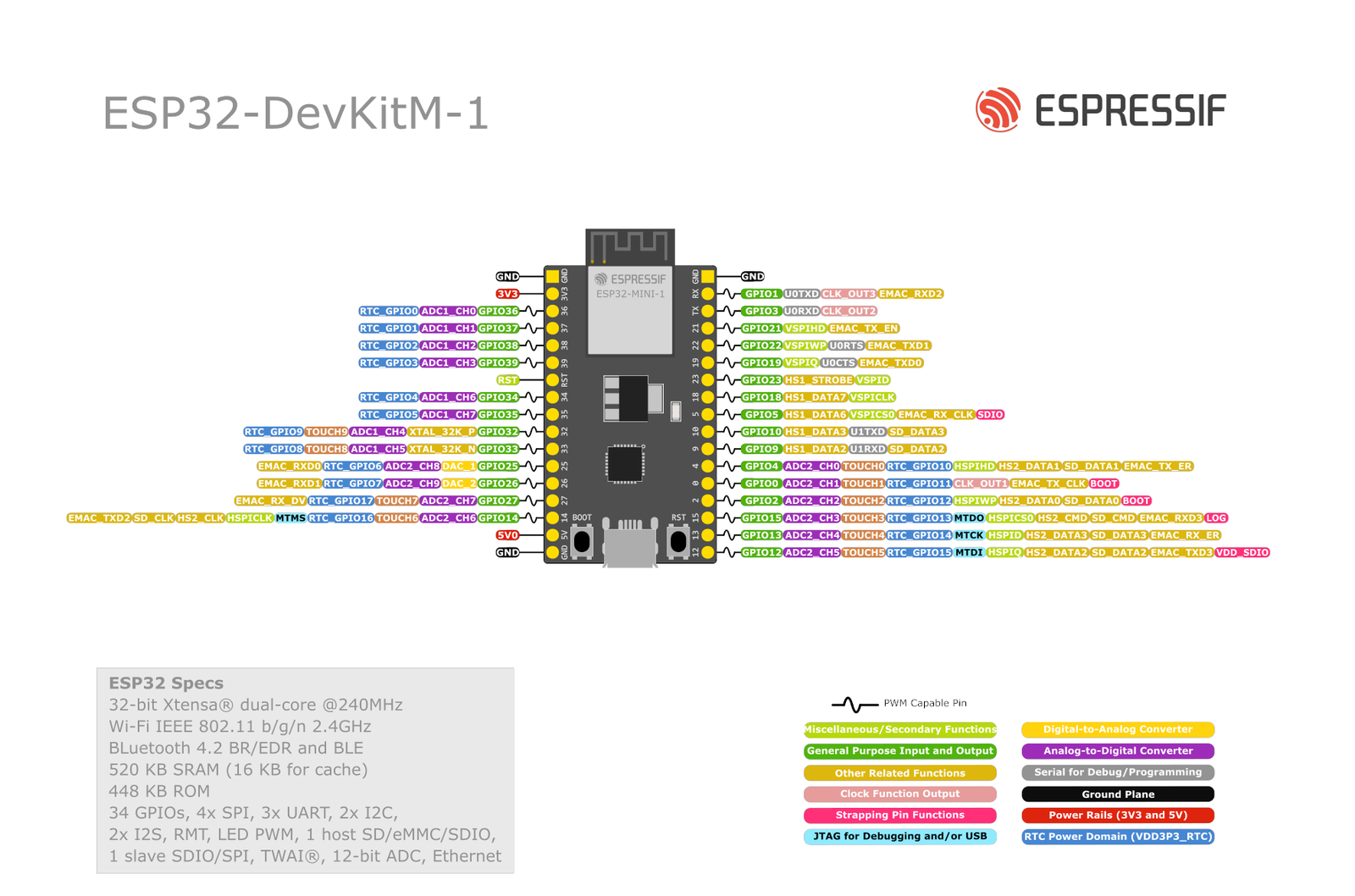
| Pin | GPIO | Labels | Status | Capabilities | Notes |
|---|---|---|---|---|---|
| 1 | 0 | A11T1PWM | strapping | adc · touch | |
| 2 | 1 | TXPWM | uart | uart | |
| 3 | 2 | A12T2PWM | strapping | adc · touch | |
| 4 | 3 | RXPWM | uart | uart | |
| 5 | 4 | A10T0PWM | strapping | adc · touch | |
| 6 | 5 | PWM | strapping | - | |
| 7 | 12 | A15T5PWM | strapping | adc · touch | |
| 8 | 13 | A14T4PWM | strapping | adc · touch | |
| 9 | 14 | A16T6PWM | strapping | adc · touch | |
| 10 | 15 | A13T3PWM | strapping | adc · touch | |
| 11 | 16 | PWM | strapping | - | |
| 12 | 17 | PWM | strapping | - | |
| 13 | 18 | PWM | safe | - | |
| 14 | 19 | PWM | safe | - | |
| 15 | 21 | PWM | safe | - | |
| 16 | 22 | PWM | safe | - | |
| 17 | 23 | PWM | safe | - | |
| 18 | 25 | A18DAC1PWM | safe | adc · dac | |
| 19 | 26 | A19DAC2PWM | safe | adc · dac | |
| 20 | 27 | A17T7PWM | safe | adc · touch | |
| 21 | 32 | A4T9PWM | safe | adc · touch | |
| 22 | 33 | A5T8PWM | safe | adc · touch | |
| 23 | 34 | A6 | strapping | adc | |
| 24 | 35 | A7 | strapping | adc | |
| 25 | 36 | A0 | strapping | adc | |
| 26 | 39 | A3 | strapping | adc |
Start with these
10 pins with no boot or system involvementFreely assignable - no strapping, flash, USB or JTAG duties. Ideal first picks for buttons, sensors and LEDs.
Fine - with a little care
sampled at boot or shared with debug/serial| Pin | Label | What to know | Role |
|---|---|---|---|
| A11 | GPIO0 | Must be HIGH during boot for normal startup; if held LOW on reset, forces flash programming mode. | Strapping |
| A12 | GPIO2 | If driven HIGH on reset (while IO0 is LOW), selects an unsupported SDIO boot mode, causing boot failure. | Strapping |
| A10 | GPIO4 | Sampled at reset for boot config; should not be driven at boot (affects boot mode timing). | Strapping |
| PWM | GPIO5 | Must be HIGH during boot; if pulled LOW at reset, alters SDIO slave timing and may prevent normal boot. | Strapping |
| A15 | MTDI (GPIO12) | Keep LOW during boot (internal PD); pulling HIGH at reset selects 1.8V flash mode, causing flash brownout if 3.3V flash is used. | Strapping |
| A14 | MTCK (GPIO13) | Used for JTAG debugging (TCK); avoid using as GPIO if JTAG is needed. | Other |
| A16 | MTMS (GPIO14) | Used for JTAG debugging (TMS); driving it as GPIO may interfere with JTAG or produce spurious signals at boot. | Other |
| A13 | MTDO (GPIO15) | Keep HIGH during boot (internal PU); if LOW on reset, bootloader log is silenced and boot mode may change. | Strapping |
| PWM | GPIO16 | Wired to the memory die on PSRAM-equipped modules (WROVER, PICO-V3-02) and on in-package-memory chip variants (U4WDH, D0WDRH2-V3); an ordinary GPIO on a plain WROOM-32. | PSRAM |
| PWM | GPIO17 | Wired to the memory die on PSRAM-equipped modules (WROVER, PICO-V3-02) and on in-package-memory chip variants (U4WDH, D0WDRH2-V3); an ordinary GPIO on a plain WROOM-32. | PSRAM |
| A6 | GPIO34 | Cannot be used as output (no drive capability); only suitable for analog/digital input. | Other |
| A7 | GPIO35 | Cannot be used as output; only suitable for input. | Other |
| A0 | GPIO36 (SENSOR_VP) | Cannot be used as output; only suitable for input (e.g., analog read). | Other |
| A3 | GPIO39 (SENSOR_VN) | Cannot be used as output; only suitable for input. | Other |
Only if you know the tricks
wired to flash or USB - expect a fight| Pin | Label | What to know | Role |
|---|---|---|---|
| TX | U0TXD (GPIO1) | Connected to on-board USB-UART for uploading and logs; drives serial output at boot, so using as GPIO can disrupt programming or console. | USB |
| RX | U0RXD (GPIO3) | Used for receiving data from USB-UART (programming); also pulled HIGH at boot for console communication, so using as GPIO can disrupt uploads. | USB |
Pinout notes The Espressif ESP32-DevKitM-1 pinout brings out 26 GPIO pins at a 2.54 mm pitch - every one of them usable in your project. For peripherals, TX/RX on GPIO1 and…
The Espressif ESP32-DevKitM-1 pinout brings out 26 GPIO pins at a 2.54 mm pitch - every one of them usable in your project.
For peripherals, TX/RX on GPIO1 and GPIO3 cover serial logging and flashing.
On the analog side there are 16 ADC-capable pins for sensors and battery monitoring, 10 capacitive-touch inputs and 2 true DAC outputs.
If you want zero surprises, PWM, PWM, PWM, PWM and 6 more are free of any such role - the safest first picks. 14 of the exposed pins carry boot-time or system duties on the ESP32 (A11, A12, A10 and 11 more).
Getting started
flash your first firmware in ~2 minutesBoard: ESP32 Dev Module Flash Size: 4MB (32Mb) Flash Mode: DIO Partition Scheme: Default 4MB with spiffs (1.2MB APP/1.5MB SPIFFS) Upload Speed: 921600
// toggle GPIO18 - wire an LED and resistor to it
void setup() {
  pinMode(18, OUTPUT);
}
void loop() {
  digitalWrite(18, HIGH); delay(500);
  digitalWrite(18, LOW);  delay(500);
}[env:esp32-devkitm-1]
platform = espressif32
board = esp32dev
framework = arduino
monitor_speed = 115200
upload_speed = 921600esp32dev - or type it after board =.esp32:
board: esp32dev
variant: esp32
framework:
type: esp-idf
# blink - GPIO18
output:
- platform: gpio
pin: 18
id: led_out
light:
- platform: binary
name: "LED"
output: led_outesp32dev (same ids as PlatformIO).esptool.py --chip esp32 --port /dev/ttyACM0 \
--baud 921600 write_flash 0x1000 firmware.bin--port = your /dev/tty* (macOS/Linux) or COMx (Windows).Specifications
ESP32 · 43.81 × 25.4 mm · vs other ESP32 chips →About this board
At its core is the ESP32 - a dual-core Xtensa with both Bluetooth Classic and BLE.
Expect to pay about $10.00 - less than the ~$20 most ESP32 boards go for.
Onboard you'll find status LEDs (Power) and Reset/Boot buttons.
- ESP32-MINI-1 module built around the ESP32-U4WDH chip with 4 MB flash embedded in-package (no external flash IC)
- Early modules (before December 2021) are single-core; later units were upgraded to dual-core per Espressif PCN-2021-021
- No PSRAM
Where to buy
prices are typical street pricesResources
Similar boards


