
LOLIN(WEMOS) D1 R2 & mini
Compact and full-size ESP8266 dev boards - perfect for IoT projects using Arduino-style pins.

Pinout
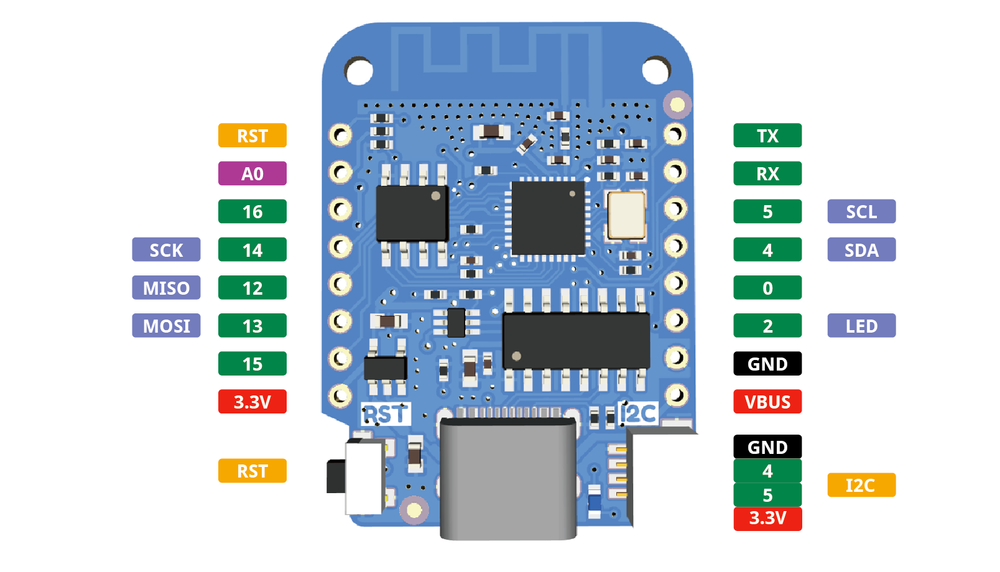
Pinout notes The pinout diagram for this ESP32-based module highlights its versatility and ease of use for IoT and embedded projects. The module includes a RST pin for…
The pinout diagram for this ESP32-based module highlights its versatility and ease of use for IoT and embedded projects. The module includes a RST pin for resetting the board, which is crucial for debugging and testing. On the power side, the board provides a 3.3V output pin and VBUS for powering external components, along with multiple GND pins to ensure proper grounding.
This pinout features a range of GPIO pins, such as GPIO16, GPIO14, GPIO15, and GPIO4, all of which are multi-functional and can be used for both digital I/O and peripheral interfacing. Communication protocols are well-supported, with dedicated pins for SPI, including SCK (GPIO14), MISO (GPIO12), and MOSI (GPIO13). These pins enable high-speed communication with external devices like sensors, displays, and storage modules.
For I2C communication, the board uses GPIO5 for SCL and GPIO4 for SDA, making it easy to connect to peripherals like temperature sensors, accelerometers, or OLED displays. A built-in LED is connected to GPIO2, allowing developers to use it for visual feedback or debugging during project development.
Getting started
flash your first firmware in ~2 minutesBoard: Generic ESP8266 Module Flash Size: 4MB (32Mb) CPU Frequency: 160 MHz Upload Speed: 921600
// toggle GPIO2 - wire an LED and resistor to it
void setup() {
  pinMode(2, OUTPUT);
}
void loop() {
  digitalWrite(2, HIGH); delay(500);
  digitalWrite(2, LOW);  delay(500);
}
Specifications
ESP8266 · 34.2 × 25.6 mmAbout this board
At $5.00 it's cheaper than most ESP8266 boards, which usually run around $15.
The LOLIN(WEMOS) D1 mini (also written as WeMos D1 mini, LOLIN D1 mini, or D1 Mini) is a compact ESP8266 development board built around Espressif's ESP-8266EX chip, a CH340 USB-to-serial converter, and 4 MB of flash. Measuring just 34.2 x 25.6 mm, it offers 11 digital IO pins, 1 analog input, and a wide "mini shield" ecosystem for easy expansion. It's popular for Wi-Fi IoT projects, sensor nodes, and home automation. In this guide, you'll find the WeMos D1 mini pinout, datasheet, technical specs, and setup instructions.
Resources
Similar boards


