
LOLIN (WeMos) D1 R1
Early version of D1 board - Uno-style ESP8266 layout for legacy compatibility and basic Wi-Fi.

68.6 × 53.4 mm
ESP8266
MCU
160MHz
clock
4MB
flash
~80KB
SRAM
17· 1 ADC
GPIO
Wi-Fi
radio
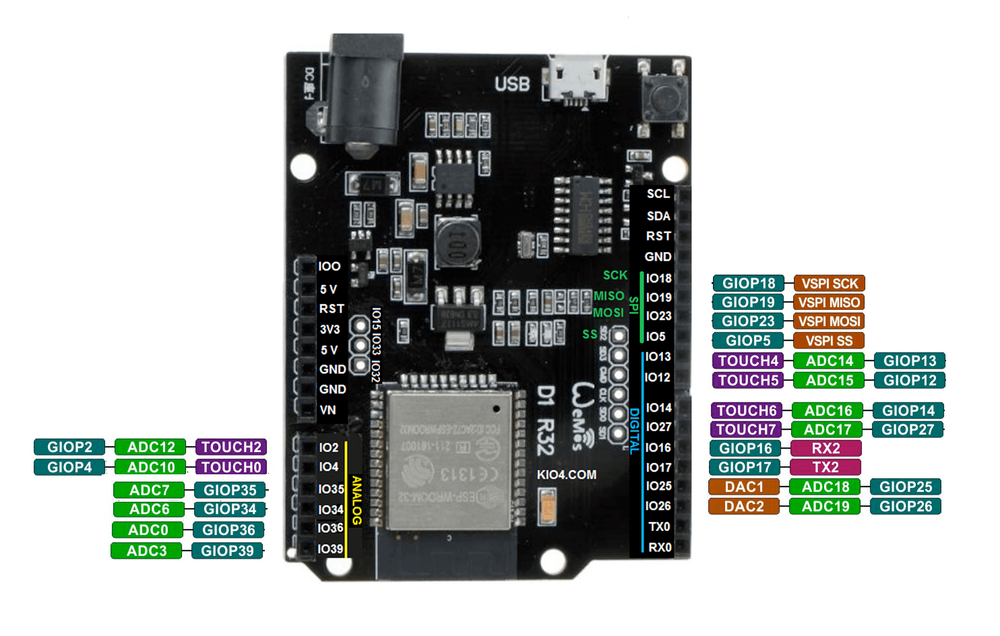
LOLIN (WeMos) D1 R1 Pinout
Getting started
flash your first firmware in ~2 minutes1
Connect over USB
Uses a CH340 bridge - install the CH340 driver if no port appears. Not detected? Hold BOOT while plugging in.
2
Match & flash
Set the Tools options shown, then click Upload.
3
Verify it runs
GPIO2 toggles - wire an LED and resistor to it, or change the pin to your board's own LED.
Set these in Tools · leave everything else at default
Arduino IDE 2.x - Tools Copy
Board: "Generic ESP8266 Module"▸
Flash Size: "4MB (32Mb)"▸
CPU Frequency: "160 MHz"▸
Upload Speed: "921600"▸
▸ every other Tools option - leave at default
Board: Generic ESP8266 Module
Flash Size: 4MB (32Mb)
CPU Frequency: 160 MHz
Upload Speed: 921600
Find it: Tools ▸ Board ▸ ESP8266 Boards ▸ Generic ESP8266 Module
// toggle GPIO2 - wire an LED and resistor to it
void setup() {
  pinMode(2, OUTPUT);
}
void loop() {
  digitalWrite(2, HIGH); delay(500);
  digitalWrite(2, LOW);  delay(500);
}
Specifications
ESP8266 · 68.6 × 53.4 mmCompute
MCU
ESP8266
Clock
160 MHz
SRAM · Flash
~80 KB · 4 MB
Radio
Wi-Fi
802.11 b/g/n
Bluetooth
-
Antenna
PCB
I/O
GPIO · ADC
17 · 1
UART · I²C · SPI
2 · 1 (software) · 1
PWM
-
Power
USB
Micro-USB
Serial
CH340
Boot address
0x0000
Electrical
Input
5V via USB · 3.3V logic
Consumption
-
Regulator
AMS1117-3.3
Flashing
Upload · OTA
esptool · esp_ota
Flash · Boot mode
DIO · -
Sketch · Data
- · 80 KB
Dimensions
68.6 × 53.4 mm · pin pitch 2.54 mm
The LOLIN (WeMos) D1 R1 uses esptool for firmware uploads, esp_ota for over-the-air (OTA) updates. Flash mode is DIO.
About this board
At $10.00 it's cheaper than most ESP8266 boards, which usually run around $15.
The LOLIN (WeMos) D1 R1 (also written as WeMos D1, WeMos D1 R1, or LOLIN D1) is a Wi-Fi development board built around Espressif's ESP8266EX chip in an Arduino Uno form factor. It uses a CH340 USB-to-serial chip for micro-USB programming and provides 4 MB of flash, 11 digital I/O pins, and a single analog input. The Uno-style headers make it a handy way to add Wi-Fi to Arduino Uno projects and reuse many existing shields, keeping in mind its 3.3V logic levels. In this guide, you'll find the WeMos D1 pinout, datasheet, technical specs, and setup instructions.
Resources
Board datasheet handsontec.com↗ ESP8266 datasheet espressif.com↗ WEMOS D1 R1 Pinouts, Specs, and Examples - Cirkit Designer docs.cirkitdesigner.com↗WeMos D1 ESP8266 Arduino Compatible - Specs and How to Use It electroniclinic.com↗Getting Started with the WeMos D1 ESP8266 WiFi Board - Cyan Infinite cyaninfinite.com↗
Similar boards


