
LilyGo T-Embed is a development board based on the ESP32S3 microcontroller using XTENSA architecture.
This board features a maximum CPU frequency of 240 MHz and 16MB flash memory.
About LilyGo T-Embed
🚀 The LilyGo T-Embed is an ESP32-S3-based development board designed for versatile embedded applications. With an integrated 1.54-inch IPS LCD touch screen and a rotary encoder, it is perfect for UI-based projects. ⚡
📡 Featuring WiFi 802.11 b/g/n and Bluetooth 5 (LE), the T-Embed allows seamless wireless connectivity for IoT and automation applications.
💾 Equipped with 8MB PSRAM and 16MB Flash, it is capable of handling complex processing tasks efficiently.
Technical Specifications
Complete technical specification details for LilyGo T-Embed
Display
USB
Connectivity
Microcontroller
✨ Features & Pins
Quick Setup
Copy-paste configs for LilyGo T-Embed - auto‑generated from this board's exact hardware specs.
In Arduino IDE 2 select Lilygo T Embed from the esp32 by Espressif package. In PlatformIO use board = esp32-s3-devkitm-1. ESP32S3 · 240 MHz · 16MB · DIO.
In Arduino IDE 2, open Boards Manager, search "esp32" by Espressif and install it. Then go to Tools → Board and select "Lilygo T Embed" for the LilyGo T-Embed.
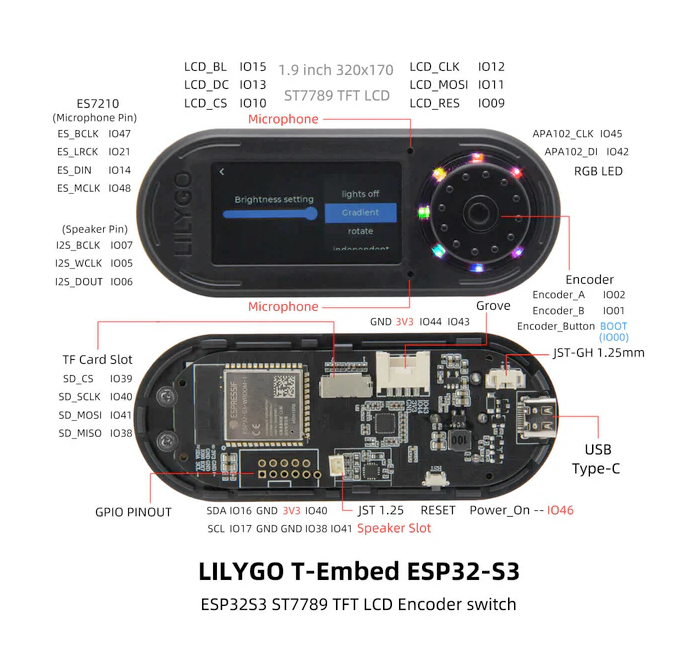
LilyGo T-Embed Pinout Diagram
Complete pin reference for LilyGo T-Embed
Safe Pins to Use
These pins are safe for general GPIO usage without boot or system conflicts
Why Are These Pins Safe?
Pins to Avoid or Use with Caution
Reserved for critical functions. Misuse may cause boot failures, programming issues, or system conflicts.
Boot behavior & flash voltage
Low-level debugging interface
USB Serial/JTAG communication
Memory & PSRAM connections
Debugging & firmware uploads
| PIN | Label | Why Avoid | Type |
|---|---|---|---|
| IO3 | GPIO3 | Sampled at reset to select JTAG interface (USB Serial/JTAG controller vs. external pins). Improper use can disable external JTAG or alter debug interface. | 🛠️ Strapping |
| IO19 | USB_D- | By default connected to the on-chip USB Serial/JTAG controller. Using it as general GPIO without reconfiguring IO MUX will interfere with USB functionality. | 🔌 USB |
Useful Links
Datasheets and resources for LilyGo T-Embed
LilyGo T-Embed Custom Pin Mapping
Pin configuration and GPIO mapping for LilyGo T-Embed
| Pin | Function | ESP Pin | I/O Type | Description |
|---|---|---|---|---|
| 1 | 3V3 | 3.3V | POWER OUTPUT | 3.3V power output |
| 2 | GND | GND | POWER GROUND | Ground connection |
| 3 | 5V | 5V | POWER INPUT | 5V power input |
| 4 | IO1 | GPIO1 | BIDIRECTIONAL | GPIO, ADC, I2C |
| 5 | IO2 | GPIO2 | BIDIRECTIONAL | GPIO, ADC |
| 6 | IO3 | GPIO3 | BIDIRECTIONAL | GPIO, ADC |
| 7 | IO16 | SPI_CS | BIDIRECTIONAL | GPIO, SPI Chip Select |
| 8 | IO17 | SPI_D | BIDIRECTIONAL | GPIO, SPI Data |
| 9 | IO18 | SPI_CLK | BIDIRECTIONAL | GPIO, SPI Clock |
| 10 | IO19 | SPI_Q | BIDIRECTIONAL | GPIO, SPI Q |
| 11 | IO21 | LCD_DC | OUTPUT | GPIO, LCD Data/Command |
| 12 | IO22 | LCD_RST | OUTPUT | GPIO, LCD Reset |
| 13 | IO23 | LCD_BL | OUTPUT | GPIO, LCD Backlight |
| 14 | IO25 | TOUCH_SDA | BIDIRECTIONAL | GPIO, I2C Data for Touch |
| 15 | IO26 | TOUCH_SCL | BIDIRECTIONAL | GPIO, I2C Clock for Touch |
| 16 | IO27 | ENCODER_A | INPUT | GPIO, Rotary Encoder A |
| 17 | IO28 | ENCODER_B | INPUT | GPIO, Rotary Encoder B |
| 18 | IO29 | ENCODER_SWITCH | INPUT | GPIO, Rotary Encoder Switch |
Default Tools & Configuration
Build and upload settings for LilyGo T-Embed
| Setting | Value |
|---|---|
| Bootloader tool | esptool_py |
| Uploader tool | esptool_py |
| Network uploader tool | esp_ota |
| Bootloader address | 0x0 |
| Flash mode | dio |
| Boot mode | qio |
| PSRAM type | opi |
| Maximum upload size | 3072 KB (3145728 bytes) |
| Maximum data size | 320 KB (327680 bytes) |
The LilyGo T-Embed uses esptool_py for uploads , esp_ota for OTA updates, and esptool_py bootloader at 0x0.
Flash mode: dio | Boot mode: qio | PSRAM: opi
Max sketch size: 3072 KB | Max data size: 320 KB
Similar Boards
Other development boards with ESP32S3 microcontroller

LilyGo T4-S3
LilyGo T4-S3 development board is based on esp32s3 microcontroller and uses xtensa architecture.

LilyGo T-Dongle S3
LilyGo T-Dongle S3 development board is based on esp32s3 microcontroller and uses xtensa architecture.

TTGO T1
TTGO T1 development board is based on esp32 microcontroller and uses xtensa architecture.