
WEMOS LOLIN32 Lite
Compact ESP32 board with Wi-Fi, BLE, and built-in LiPo charging - ideal for portable, battery-powered IoT projects.

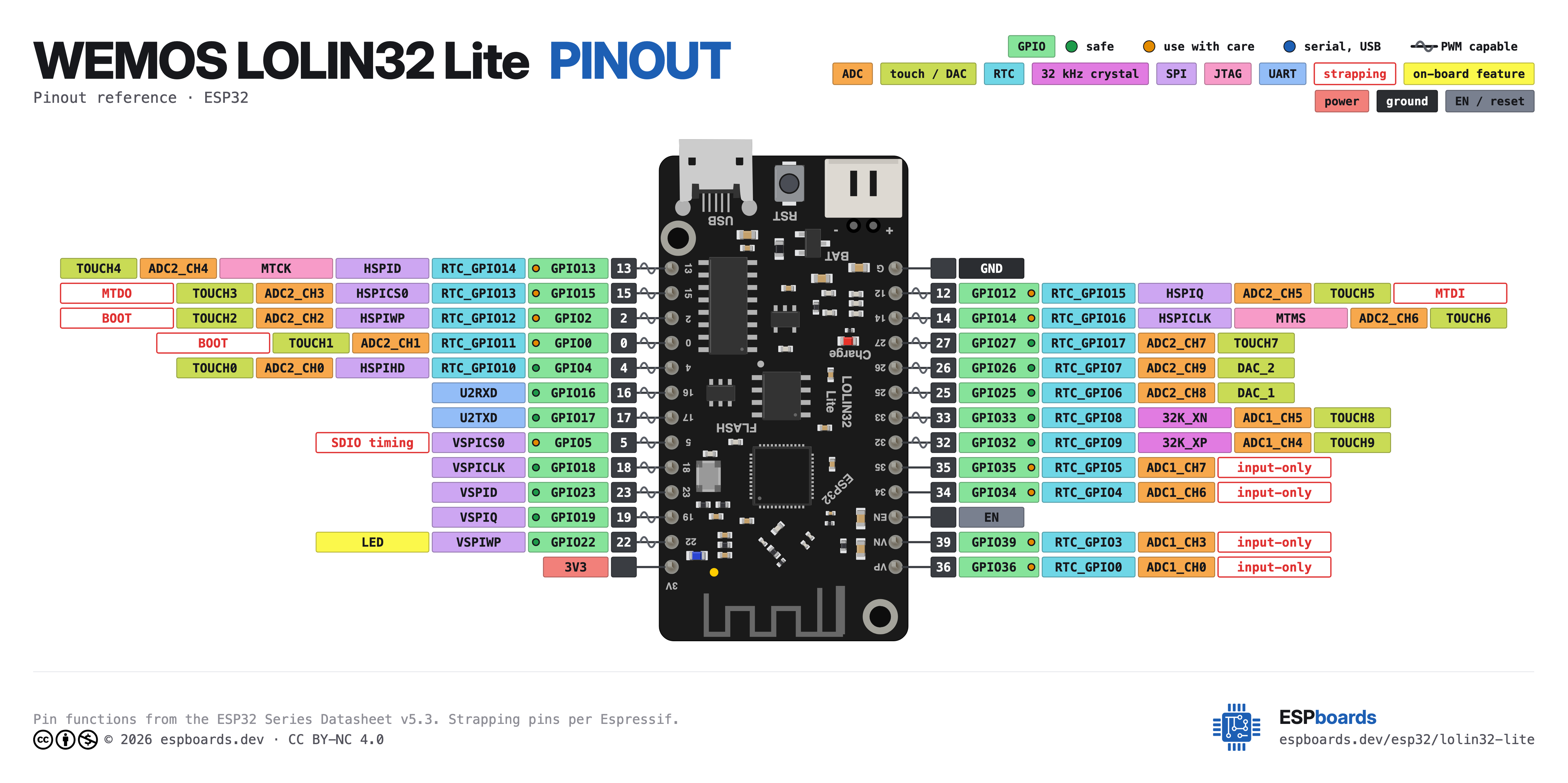
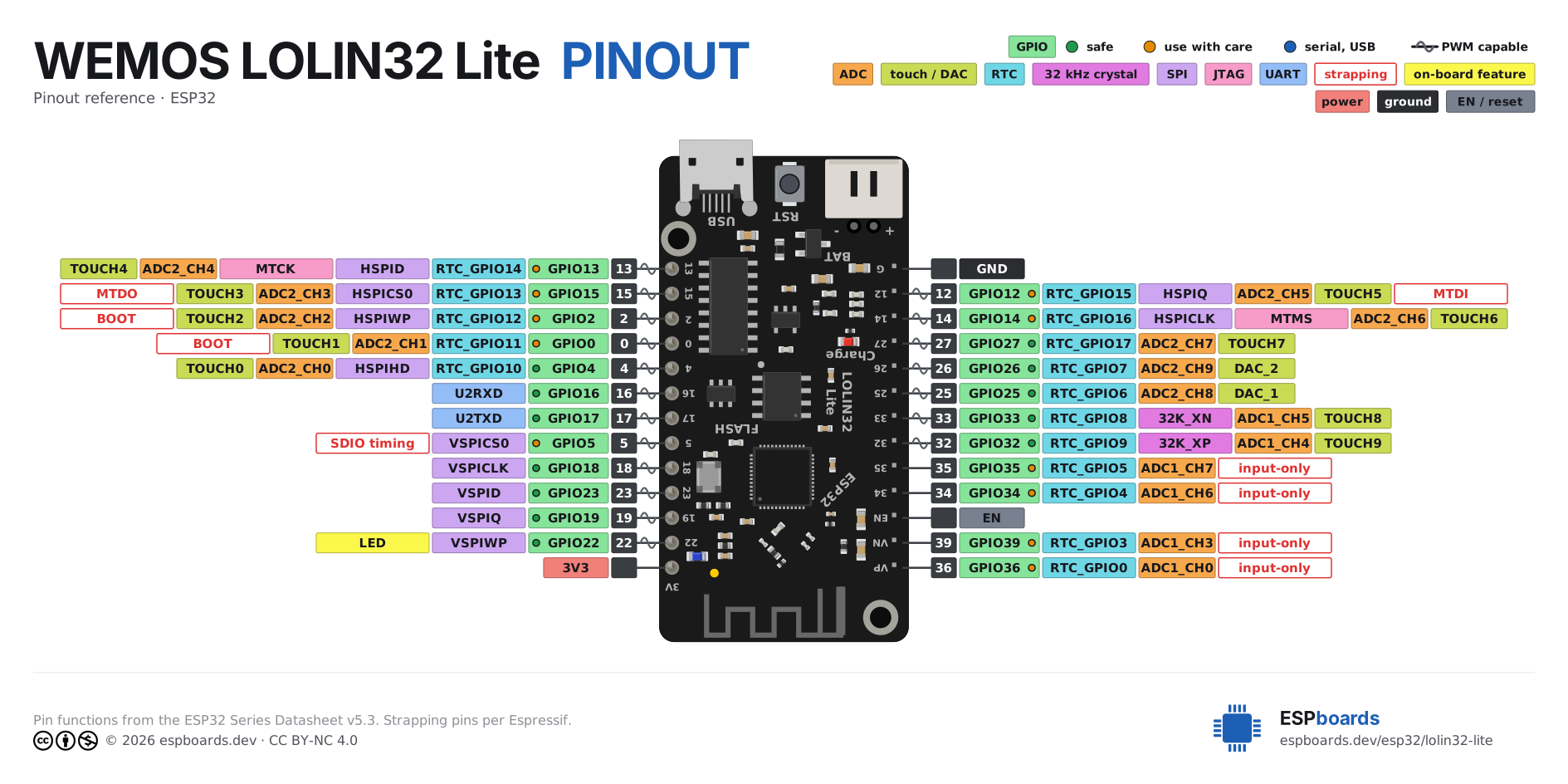
WEMOS LOLIN32 Lite Pinout
26 pins · 2.54 mm pitch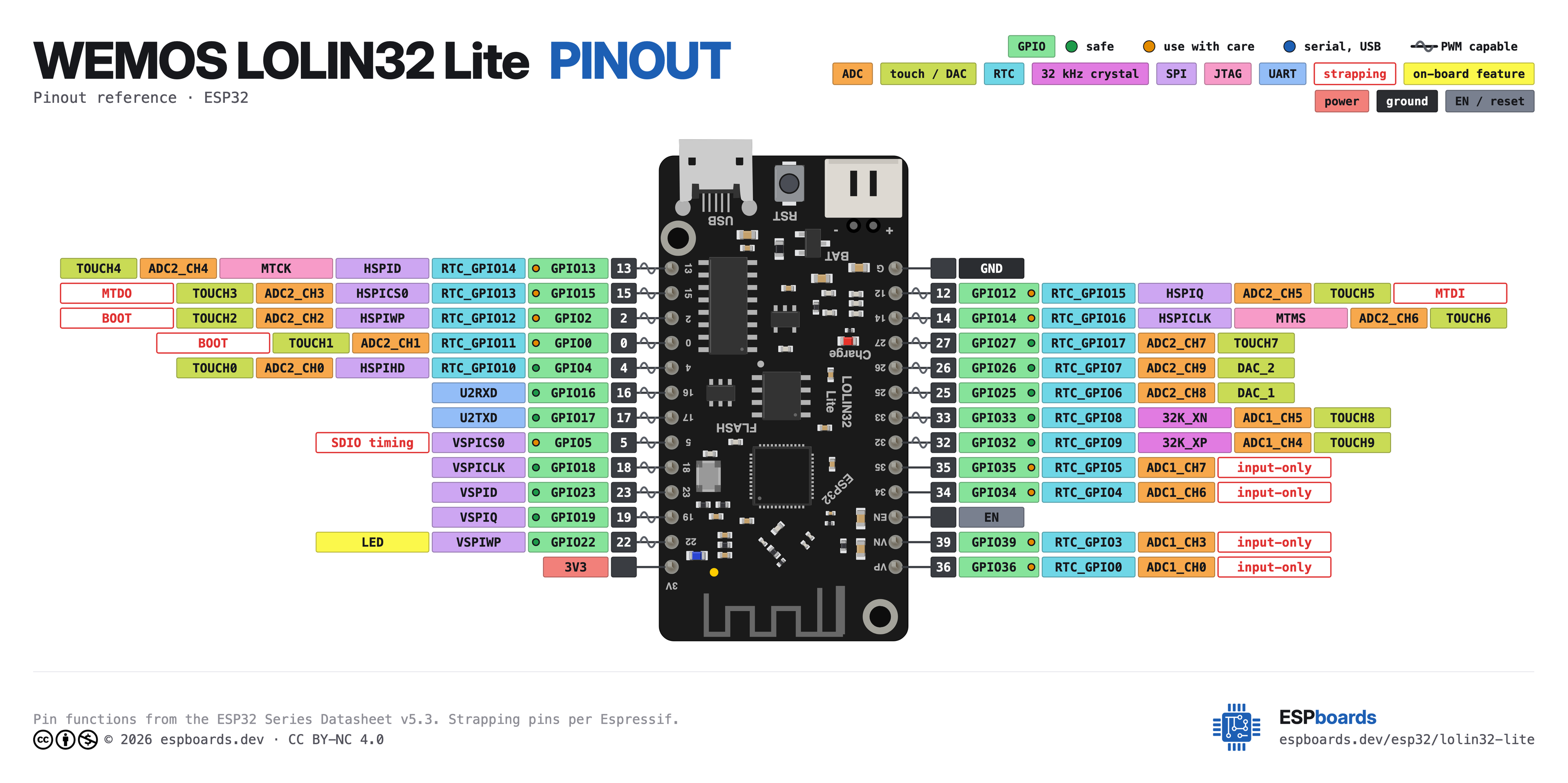
| Pin | GPIO | Labels | Status | Capabilities | Notes |
|---|---|---|---|---|---|
| 1 | - | GND | ground | - | Ground connection |
| 2 | - | 3V33.3V | power | - | 3.3V power output |
| 3 | 0 | IO0GPIO0 | strapping | adc | GPIO, ADC |
| 4 | 2 | IO2GPIO2 | strapping | adc | GPIO, ADC |
| 5 | 4 | IO4GPIO4 | safe | adc | GPIO, ADC |
| 6 | 5 | IO5GPIO5 | strapping | - | GPIO |
| 7 | 12 | IO12GPIO12 | strapping | adc | GPIO, ADC |
| 8 | 13 | IO13GPIO13 | strapping | adc | GPIO, ADC |
| 9 | 14 | IO14GPIO14 | strapping | adc | GPIO, ADC |
| 10 | 15 | IO15GPIO15 | strapping | - | GPIO |
| 11 | 16 | IO16GPIO16 | safe | - | GPIO |
| 12 | 17 | IO17GPIO17 | safe | - | GPIO |
| 13 | 18 | IO18GPIO18 | safe | - | GPIO |
| 14 | 19 | IO19GPIO19 | safe | - | GPIO |
| 15 | 22 | IO22GPIO22 | safe | - | GPIO |
| 16 | 23 | IO23GPIO23 | safe | - | GPIO |
| 17 | 25 | IO25GPIO25 | safe | adc | GPIO, ADC |
| 18 | 26 | IO26GPIO26 | safe | adc | GPIO, ADC |
| 19 | 27 | IO27GPIO27 | safe | adc | GPIO, ADC |
| 20 | 32 | IO32GPIO32 | safe | adc | GPIO, ADC |
| 21 | 33 | IO33GPIO33 | safe | adc | GPIO, ADC |
| 22 | - | EN | control | - | Chip enable (active HIGH) - the RST button pulls it low; a 10k pull-up holds it high |
| 23 | 34 | IO34GPIO34 | strapping | adc | GPIO, ADC |
| 24 | 35 | IO35GPIO35 | strapping | adc | GPIO, ADC |
| 25 | 36 | IO36GPIO36 | strapping | adc | GPIO, ADC |
| 26 | 39 | IO39GPIO39 | strapping | adc | GPIO, ADC |
Start with these
12 pins with no boot or system involvementFreely assignable - no strapping, flash, USB or JTAG duties. Ideal first picks for buttons, sensors and LEDs.
Fine - with a little care
11 pins · 10 things to knowIO0 Bootstrapping pin (enter bootloader when low); internal pull-up. Strapping
Must be HIGH during boot for normal startup; if held LOW on reset, forces flash programming mode.
IO2 Bootstrapping pin (must be low or floating at reset); internal pull-down. Strapping
If driven HIGH on reset (while IO0 is LOW), selects an unsupported SDIO boot mode, causing boot failure.
IO5 Bootstrapping pin; internal pull-up; VSPI CS0 (default SPI chip-select); acts as FSPIWP (flash write-protect) on internal-flash variants. Strapping
Must be HIGH during boot; if pulled LOW at reset, alters SDIO slave timing and may prevent normal boot.
IO12 Bootstrapping pin; JTAG TDI; sets flash voltage (VDD_SDIO); also HSPIQ (flash data line). Strapping
Keep LOW during boot (internal PD); pulling HIGH at reset selects 1.8V flash mode, causing flash brownout if 3.3V flash is used.
IO13 JTAG clock pin (TCK); also ADC2 channel 4 / Touch4 input. JTAG
Used for JTAG debugging (TCK); avoid using as GPIO if JTAG is needed.
IO14 JTAG mode select pin (TMS); also HSPI CLK and PWM-capable GPIO. JTAG
Used for JTAG debugging (TMS); driving it as GPIO may interfere with JTAG or produce spurious signals at boot.
IO15 Bootstrapping pin; JTAG TDO; controls UART0 boot log output; also HSPICS0 (secondary SPI CS). Strapping
Keep HIGH during boot (internal PU); if LOW on reset, bootloader log is silenced and boot mode may change.
IO34 Input-only GPIO (no output driver); ADC1 channel 6. Other
Cannot be used as output (no drive capability); only suitable for analog/digital input.
IO35IO39 Input-only GPIOs with ADC1 channels - no output driver Other
Cannot be used as output; only suitable for input.
- IO35Input-only GPIO (no output driver); ADC1 channel 7.
- IO39Input-only GPIO (no output); ADC1 channel 3, Hall sensor VN.
IO36 Input-only GPIO (no output); ADC1 channel 0, Hall sensor VP. Other
Cannot be used as output; only suitable for input (e.g., analog read).
The WEMOS LOLIN32 Lite pinout brings out 26 pins at a 2.54 mm pitch - 23 usable GPIO alongside the GND and 3V3 power rails.
On the analog side there are 15 ADC-capable pins for sensors and battery monitoring.
If you want zero surprises, IO4, IO16, IO17, IO18 and 8 more are free of any such role - the safest first picks. 11 of the exposed pins carry boot-time or system duties on the ESP32 (IO0, IO2, IO5 and 8 more).
Pinout notes The LOLIN32 Lite pinout fans out 26 ESP32 GPIOs on two rows, mirroring the original D1-mini shield headers for easy stacking. Power rails: use USB 5V (or VIN)…
The LOLIN32 Lite pinout fans out 26 ESP32 GPIOs on two rows, mirroring the original D1-mini shield headers for easy stacking.
Power rails: use USB 5V (or VIN) as input, the regulated 3V3 pin for logic-level peripherals, and the dedicated BAT pin for a single-cell Li-Po. Multiple GND pads provide solid returns.
Serial: U0_TX (GPIO1) and U0_RX (GPIO3) connect to the CH340C for programming/logging. Need more ports? U2_TX (GPIO17) and U2_RX (GPIO16) are free for GPS or RS-485 transceivers.
I²C defaults to SDA (GPIO21) and SCL (GPIO22), broken out on the shield D2/D1 lines-but any spare GPIO can be reassigned.
SPI: the primary VSPI bus (best for OLEDs, SD adapters, radios) maps to MOSI (GPIO23), MISO (GPIO19), SCK (GPIO18), and CS (GPIO5). A secondary HSPI bus lives on GPIO12-15 when you need a second device.
Analog & touch: Eight ADC1 channels (GPIO32-GPIO39) work even with Wi-Fi on. Extra ADC2 pads (GPIO0, 2, 4, 12-15, 25-27) share RF hardware. Dual 8-bit DAC outputs are on GPIO25 and GPIO26. Ten pads double as capacitive-touch inputs-great for touch keys or wake-up gestures.
Every GPIO can generate high-resolution PWM (up to ≈40 kHz). Remember the boot-strap pins-GPIO0, GPIO2, and GPIO15-must sit HIGH (with proper pull-ups) on reset for a normal boot.
With battery charging, robust power rails, and a shield-friendly layout, the LOLIN32 Lite pinout makes it effortless to go from breadboard prototype to compact, battery-powered product.
Getting started
flash your first firmware in ~2 minutesBoard: ESP32 Dev Module Flash Size: 4MB (32Mb) Flash Mode: DIO Partition Scheme: Default 4MB with spiffs (1.2MB APP/1.5MB SPIFFS) Upload Speed: 921600
// toggle GPIO4 - wire an LED and resistor to it
void setup() {
  pinMode(4, OUTPUT);
}
void loop() {
  digitalWrite(4, HIGH); delay(500);
  digitalWrite(4, LOW);  delay(500);
}[env:lolin32-lite]
platform = espressif32
board = esp32dev
framework = arduino
monitor_speed = 115200
upload_speed = 921600esp32dev - or type it after board =.esp32:
board: esp32dev
variant: esp32
framework:
type: esp-idf
# blink - GPIO4
output:
- platform: gpio
pin: 4
id: led_out
light:
- platform: binary
name: "LED"
output: led_outesp32dev (same ids as PlatformIO).esptool.py --chip esp32 --port /dev/ttyACM0 \
--baud 921600 write_flash 0x1000 firmware.bin--port = your /dev/tty* (macOS/Linux) or COMx (Windows).Downloads
Free for non-commercial use, credit espboards.dev · License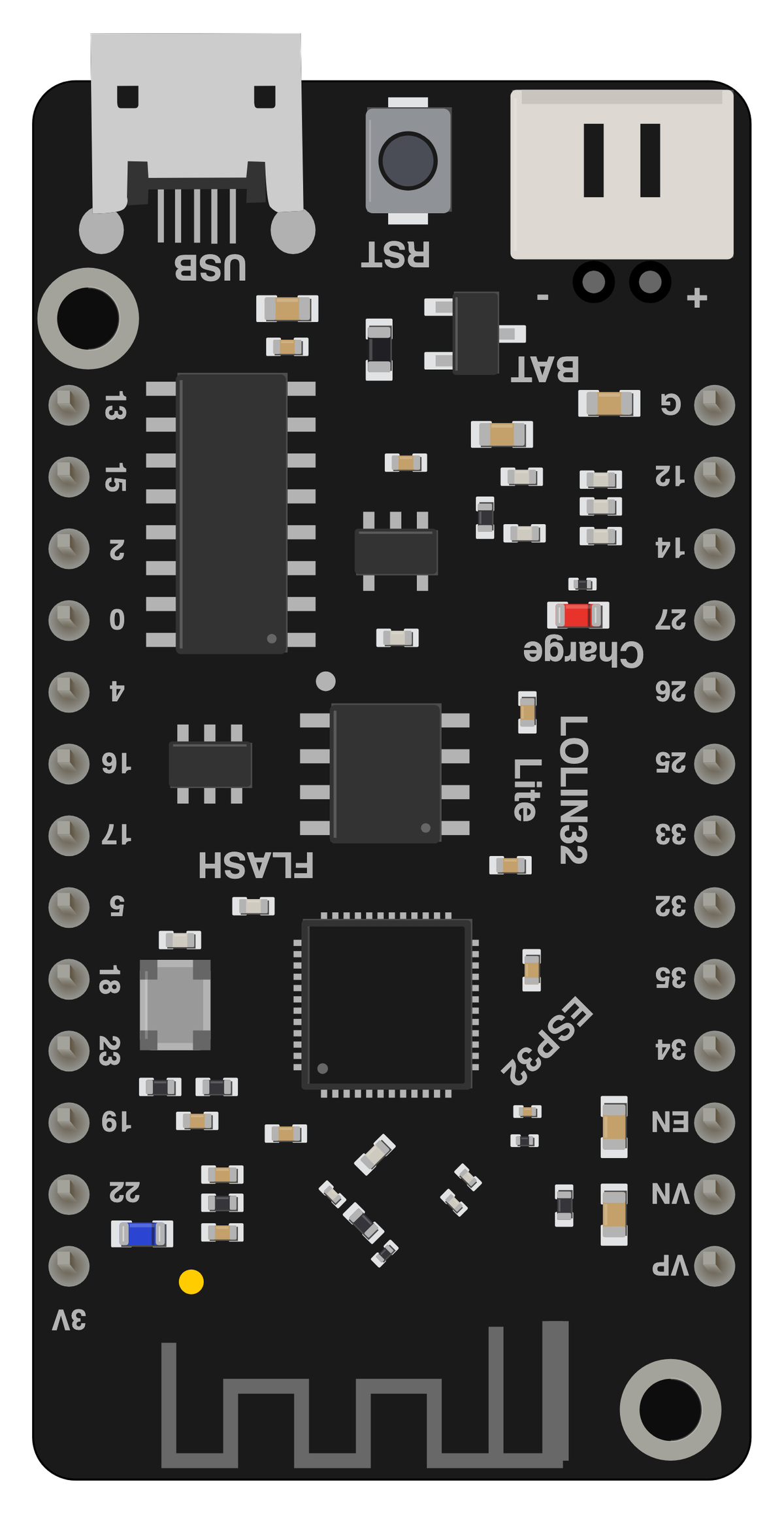
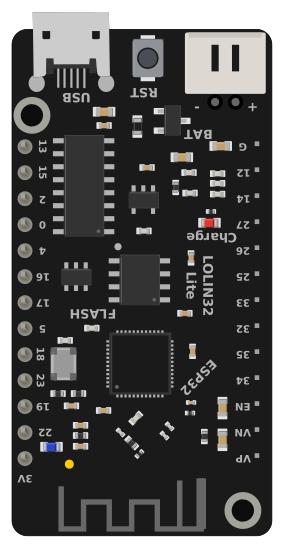
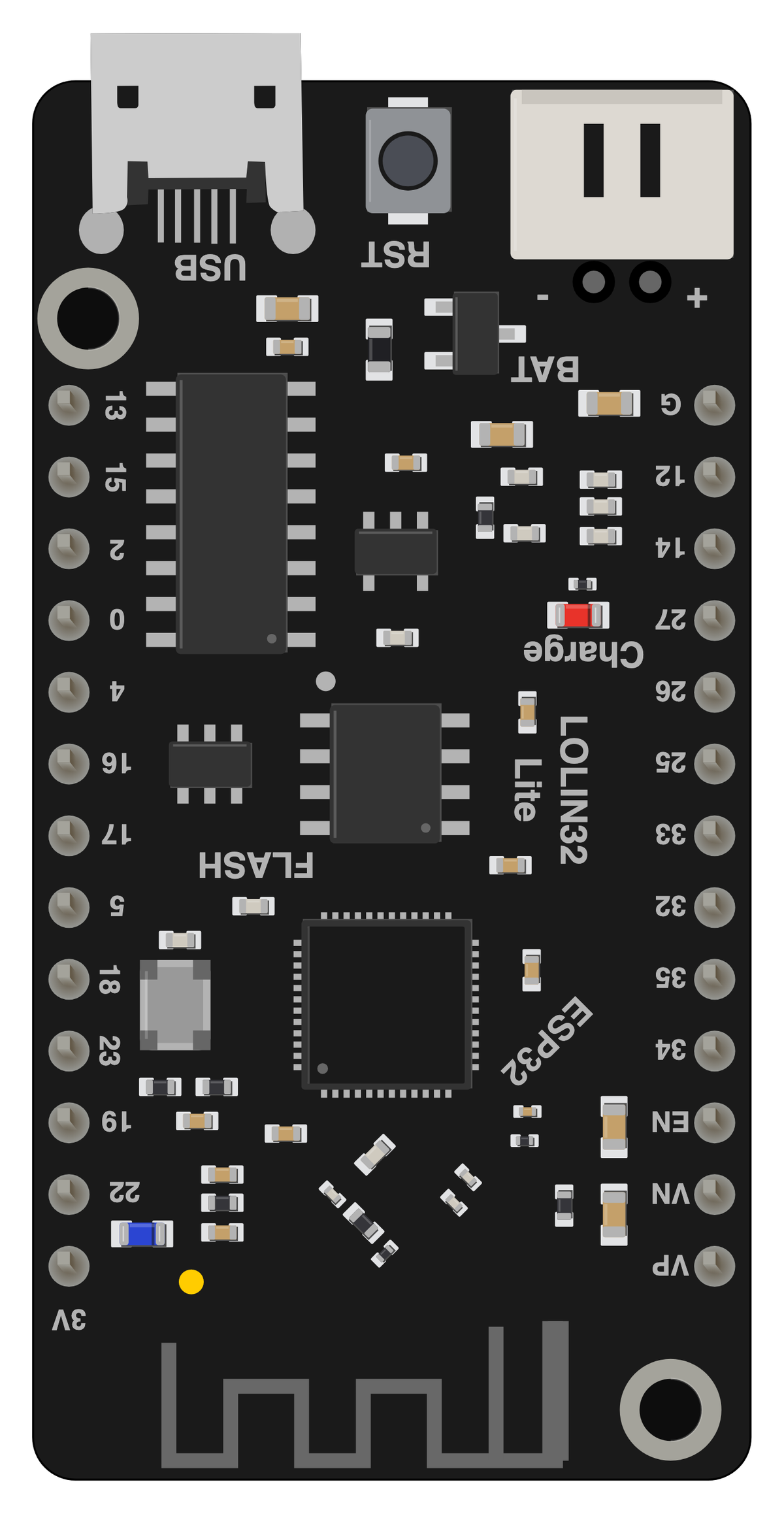
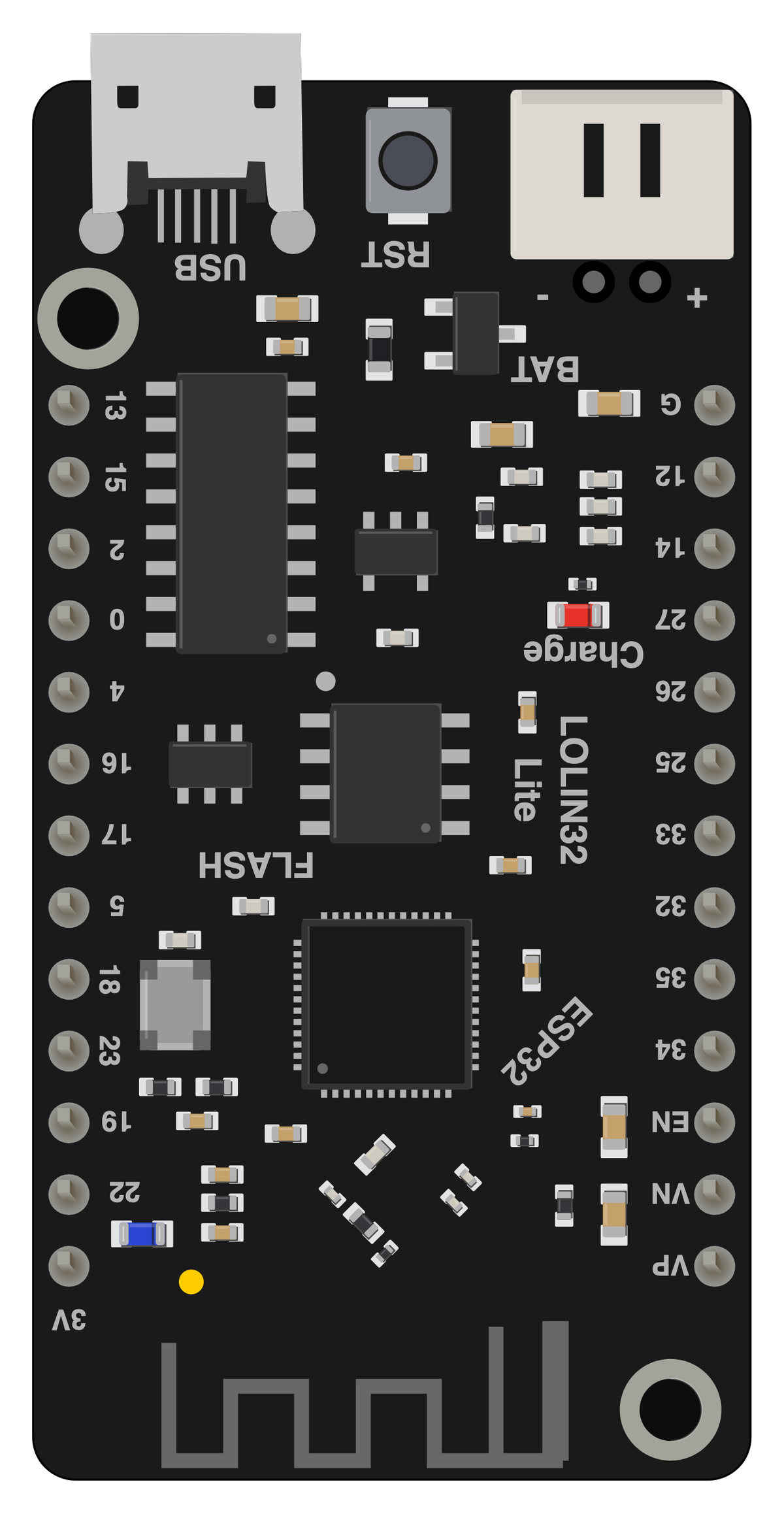
Board illustration
The bare WEMOS LOLIN32 Lite board drawn to scale at 49.5 × 25.4 mm, with no pin labels on it. Made for slide decks, wiring diagrams and project write-ups where a photo is too busy. Take the scalable SVG for print or editing, the high-resolution PNG to drop straight in, or the transparent PNG when you need it with no background behind it.
Pinout diagram
Every pin on both sides of the board with its functions, drawn by ESPboards from the ESP32 Series Datasheet v5.3 - the same sheet shown at the top of this page. The PNG is a high-resolution image for screens, the SVG is vector so it stays sharp at any size, and the PDF is laid out to print on A4 or Letter.
Yours to use, share and adapt for non-commercial work, as long as you credit espboards.dev - the full terms and ready-made credit lines are here.
Specifications
ESP32 · 49.5 × 25.4 mm · vs other ESP32 chips →Dimensions

About this board
At its core is the ESP32 - a dual-core Xtensa with both Bluetooth Classic and BLE.
Expect to pay about $5.00 - less than the ~$20 most ESP32 boards go for.
Onboard you'll find battery charging (TP4054) via JST-PH 2.0, status LEDs (Blue (GPIO22), Charge) and Reset buttons.
The WEMOS LOLIN32 Lite squeezes Espressif’s dual-core ESP32-WROOM-32 module into a slim 57 × 25 mm board that still accepts the classic LOLIN/D1-mini shield ecosystem. It ships with 4 MB of flash, runs up to 240 MHz, and offers both Wi-Fi 802.11 b/g/n and Bluetooth 4.2 (BR/EDR + BLE) for rock-solid wireless connectivity.
A low-cost CH340C USB-to-UART bridge handles programming and serial debugging via the Micro-USB port and supports auto-reset/boot so you can flash sketches without pushing buttons.
Onboard power management is Li-Po ready: a TP4054 charger (≈ 500 mA) and a PH-2 battery connector (BAT) let you run projects untethered while the board trickle-charges whenever USB is present.
Convenience extras include a RESET push-button, a BOOT (IO0) button for manual download-mode entry, and a bright blue on-board LED on GPIO 22 for quick status indication.
With 22 GPIOs (all PWM-capable), 12-bit ADCs, dual 8-bit DACs, 10 capacitive-touch pads, plus I²C, SPI, UART, SD-card, and RTC IO support, the LOLIN32 Lite punches far above its weight for battery-powered IoT nodes, wearables, or compact sensor gateways.
Where to buy
prices are typical street pricesResources
Similar boards


