
ESP32 C3 Super Mini is a development board based on the ESP32C3 microcontroller using RISCV32 architecture.
This board features a maximum CPU frequency of 160 MHz and 4MB flash memory.
About ESP32 C3 Super Mini
Have a red board?
Check ESP32 C3 Supermini Plus instead.
Designed with a compact form factor, this board is easy to integrate into space-constrained projects. Its PCB antenna ensures stable wireless performance without needing an external antenna.
For ease of use, it includes a reset button and a bootloader mode button, making development and debugging smooth.
With its versatile interfaces (UART, I2C, SPI) and plenty of GPIOs, the ESP32-C3 SuperMini is a great choice for your next embedded project.
Wondering how the ESP32-S3 SuperMini compares to other SuperMini boards? Check out our full comparison guide to see how it stacks up against the C3, C3 Plus, C6, and H2.
Where to Buy ESP32 C3 Super Mini

Starting from
3$ per unit


Prices are subject to change. We earn from qualifying purchases as an Amazon Associate.
Technical Specifications
Complete technical specification details for ESP32 C3 Super Mini
USB
Connectivity
Microcontroller
✨ Features & Pins
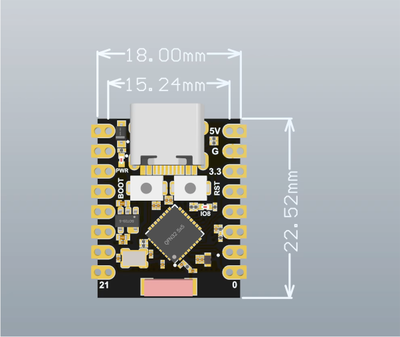
- • Ultra-small size: As small as the thumb (22.52 x 18 mm)
- • Ultra-low power consumption: deep sleep power consumption of about 43μA
- • Onboard LED blue light: GPIO8 pin
Quick Setup
Copy-paste configs for ESP32 C3 Super Mini - auto‑generated from this board's exact hardware specs.
In Arduino IDE 2 select Esp32c3 Dev from the esp32 by Espressif package. In PlatformIO use board = esp32-c3-devkitm-1. ESP32C3 · 160 MHz · 4MB · QIO · RISC-V.
In Arduino IDE 2, open Boards Manager, search "esp32" by Espressif and install it. Then go to Tools → Board and select "Esp32c3 Dev" for the ESP32 C3 Super Mini.
ESP32 C3 Super Mini Board Dimensions
Physical measurements for ESP32 C3 Super Mini
3D Printed Cases
Professional enclosures for ESP32 C3 Super Mini

Features:
ESP32 C3 Super Mini Pinout Diagram
Complete pin reference for ESP32 C3 Super Mini
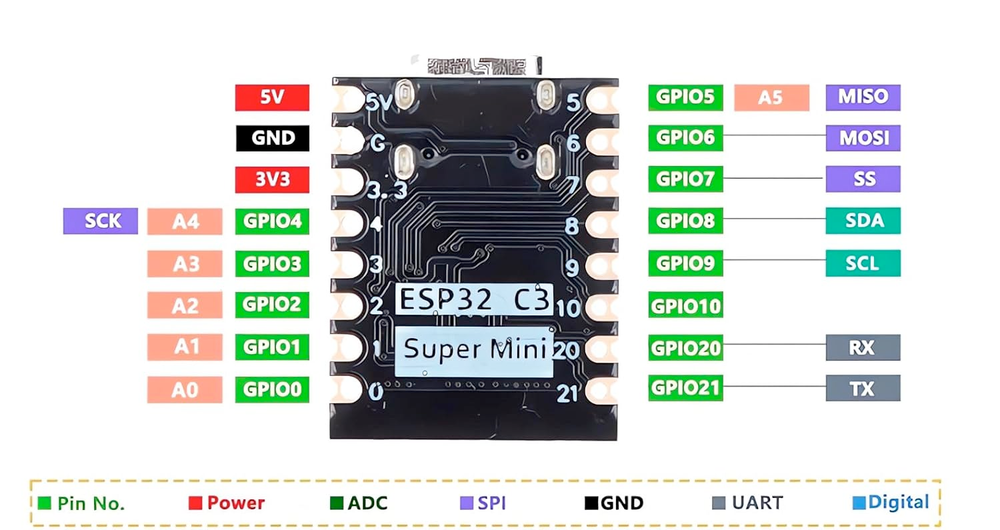
The ESP32-C3 Super Mini pinout is designed to provide maximum functionality in a most compact package. The ESP32-C3 Supermini features key power pins like 5V, 3.3V, and GND, ensuring stable power delivery for various peripherals and components.
The pinout includes dedicated communication pins, such as RX and TX for UART, SDA and SCL for I2C, and MISO, MOSI, SCK, and SS for SPI protocols. These allow seamless integration with a wide range of devices, from sensors to displays and external storage.
For analog input, the ESP32-C3 Super Mini offers ADC pins labeled A0 to A5, ideal for reading sensor data or measuring voltage levels. This flexibility makes the ESP32-C3 Supermini pinout suitable for both simple and complex projects.
Overall, the ESP32-C3 Super Mini provides a well-rounded pinout that supports digital I/O, analog input, and multiple communication protocols, despite being very small.
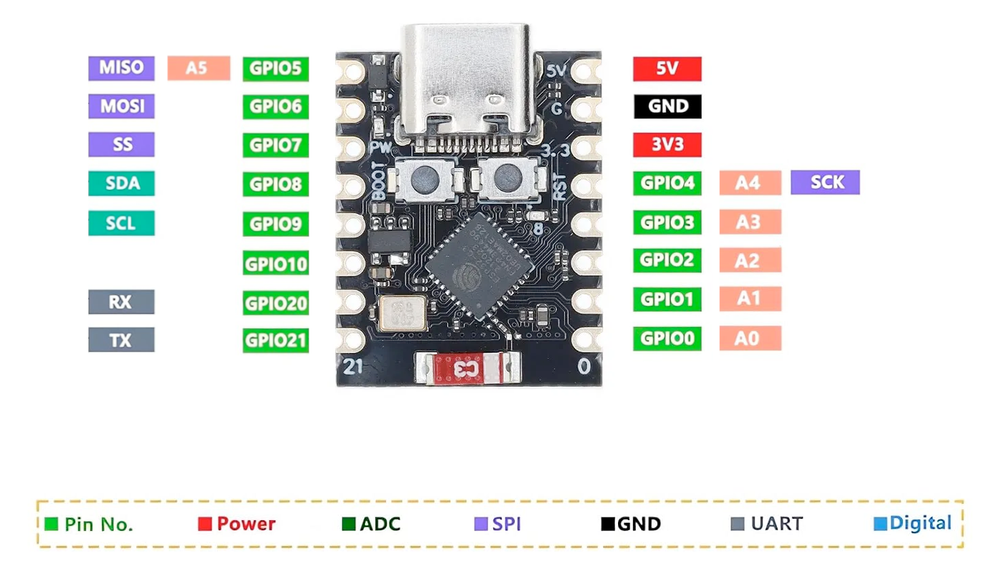
Safe Pins to Use
These pins are safe for general GPIO usage without boot or system conflicts
Why Are These Pins Safe?
Pins to Avoid or Use with Caution
Reserved for critical functions. Misuse may cause boot failures, programming issues, or system conflicts.
Boot behavior & flash voltage
Low-level debugging interface
USB Serial/JTAG communication
Memory & PSRAM connections
Debugging & firmware uploads
| PIN | Label | Why Avoid | Type |
|---|---|---|---|
| IO2 | GPIO2 | Must be held high during boot (if low on reset, normal flash boot may fail) | 🛠️ Strapping |
| IO4 | MTMS | Used during boot; JTAG TMS for debugging; acts as Quad-SPI flash IO (hold data line) in internal-flash variants | 🔗 JTAG |
| IO5 | MTDI | Used during boot; JTAG TDI for debugging; acts as Quad-SPI flash IO (write-protect data line) in internal-flash variants | 🔗 JTAG |
| IO6 | MTCK | Used during boot; JTAG TCK for debugging; provides flash clock in internal-flash variants | 🔗 JTAG |
| IO7 | MTDO | Used during boot; JTAG TDO for debugging; acts as Quad-SPI flash IO (data line) in internal-flash variants | 🔗 JTAG |
| IO8 | GPIO8 | Must be held high during reset (if low, UART flashing/boot may not work) | 🛠️ Strapping |
| IO9 | GPIO9 | Controls boot mode on reset (HIGH for normal flash boot, LOW enters serial download mode) | 🛠️ Strapping |
| IO21 | U0TXD | Used as UART0 transmit (console/bootloader); repurposing may disable serial console output and printing | 📡 UART |
| IO20 | U0RXD | Used as UART0 receive (console/bootloader); repurposing may disable serial programming and debug logs | 📡 UART |
ESP32 C3 Super Mini Additional Information
More details about ESP32 C3 Super Mini

ESP32-C3 SuperMini Expansion Board
🔌 Key Features
- Lithium Battery Compatibility: Supports 3.7V lithium battery input for portable power solutions.
- USB Charging with LED Indicator: Green LED lights up during charging and turns off when the battery is full.
- Full IO Access: Breaks out all ESP32-C3 SuperMini GPIOs for easy connectivity to sensors and modules.
- Compact Size: Measures only 37.4mm x 22.5mm x 15.2mm, ideal for compact projects.
⚙️ Advanced Power Configuration – Dual Voltage Outputs
The expansion board includes two independent power outputs: VCC1 and VCC2, both defaulting to 3.3V. You can reconfigure them to output 3.7V if needed.
How to Switch to 3.7V Output:
- Remove the pre-installed 0Ω resistor for the desired rail (VCC1 or VCC2).
- Short the three solder pads using tin to reroute the output to 3.7V.
This allows you to adapt the voltage to match your specific module or sensor requirements.
💡 Final Thoughts
This expansion board is a powerful upgrade for the ESP32-C3 SuperMini, bringing flexibility, better power control, and seamless sensor integration.
On-Board LEDs
LED indicators on ESP32 C3 Super Mini

The ESP32-C3 Supermini features two onboard LEDs with specific functions and GPIO assignments. Below is a breakdown of their roles and how to use the controllable one in both Arduino and ESPHome.
🔴 Red LED – Power Indicator
- GPIO:
None - Control: Not controllable via GPIO
- Behavior: Always on when the board is powered
🔵 Blue LED – User Controllable
- GPIO:
GPIO8 - Control:
digitalWrite(), ESPHome GPIO output
void setup() {
 pinMode(8, OUTPUT);
}

void loop() {
 digitalWrite(8, HIGH);
 delay(1000);
 digitalWrite(8, LOW);
 delay(1000);
}
output:
 - platform: gpio
 pin: 8
 id: blue_led

light:
 - platform: binary
 name: "Blue LED"
 output: blue_led
Useful Links
Datasheets and resources for ESP32 C3 Super Mini
ESP32 C3 Super Mini Custom Pin Mapping
Pin configuration and GPIO mapping for ESP32 C3 Super Mini
| Pin | Function | ESP Pin | I/O Type | Description |
|---|---|---|---|---|
| 1 | 5V | 5V | POWER INPUT | 5V power input for the board |
| 2 | GND | GND | POWER GROUNT | Ground connection |
| 3 | 3V3 | 3.3V | POWER OUTPUT | 3.3V power output |
| 4 | IO0 | A0 | BIDIRECTIONAL | GPIO, ADC pin, PWM |
| 5 | IO1 | A1 | BIDIRECTIONAL | GPIO, ADC pin, PWM |
| 6 | IO2 | A2 | BIDIRECTIONAL | GPIO, ADC pin, PWM |
| 7 | IO3 | A3 | BIDIRECTIONAL | GPIO, ADC pin, PWM |
| 8 | IO4 | A4 | BIDIRECTIONAL | GPIO, ADC pin, SCK, PWM |
| 9 | IO5 | A5 | BIDIRECTIONAL | GPIO, ADC pin, SPI Master In Slave Out, PWM |
| 10 | IO6 | MISO | BIDIRECTIONAL | GPIO, SPI Master Out Slave In, PWM |
| 11 | IO7 | SS | BIDIRECTIONAL | GPIO, SPI Slave Select, PWM |
| 12 | IO8 | SDA | BIDIRECTIONAL | GPIO, I2C Data line, PWM |
| 13 | IO9 | SCL | BIDIRECTIONAL | GPIO, I2C Clock line, PWM |
| 14 | IO10 | RX | BIDIRECTIONAL | GPIO, PWM |
| 15 | IO21 | TX | BIDIRECTIONAL | GPIO, UART Transmit |
| 16 | IO20 | RX | BIDIRECTIONAL | GPIO, UART Receive (secondary) |
Pin Mappings
Complete pinout and GPIO mapping for ESP32 C3 Super Mini
| Pin | Analog | Touch | PWM | Other |
|---|---|---|---|---|
| 0 | A0 | |||
| 1 | A1 | |||
| 2 | A2 | |||
| 3 | A3 | |||
| 4 | A4 | SCK | ||
| 5 | A5 | MISO | ||
| 6 | MOSI | |||
| 7 | SS | |||
| 8 | LED_BUILTIN SDA | |||
| 9 | SCL | |||
| 20 | RX | |||
| 21 | TX |
Default Tools & Configuration
Build and upload settings for ESP32 C3 Super Mini
| Setting | Value |
|---|---|
| Bootloader tool | esptool_py |
| Uploader tool | esptool_py |
| Network uploader tool | esp_ota |
| Bootloader address | 0x0 |
| Flash mode | qio |
| Boot mode | qio |
| Maximum upload size | 1280 KB (1310720 bytes) |
| Maximum data size | 320 KB (327680 bytes) |
The ESP32 C3 Super Mini uses esptool_py for uploads , esp_ota for OTA updates, and esptool_py bootloader at 0x0.
Flash mode: qio | Boot mode: qio
Max sketch size: 1280 KB | Max data size: 320 KB
Similar Boards
Other development boards with ESP32C3 microcontroller

ESP32-C3 OLED 0.42" Display
ESP32-C3 OLED 0.42" Display development board is based on esp32c3 microcontroller and uses riscv32...

ESP32-C3-Zero Pro
ESP32-C3-Zero Pro development board is based on esp32c3 microcontroller and uses riscv32 architecture.

Espressif ESP32-C3-DevKitC-02
Espressif ESP32-C3-DevKitC-02 development board is based on esp32c3 microcontroller and uses riscv...