
Espressif ESP32-S3-Korvo-1
Advanced ESP32-S3 audio dev board with mic array and speaker amp - ideal for smart voice interfaces and audio AI.

Espressif ESP32-S3-Korvo-1 Pinout
11 pins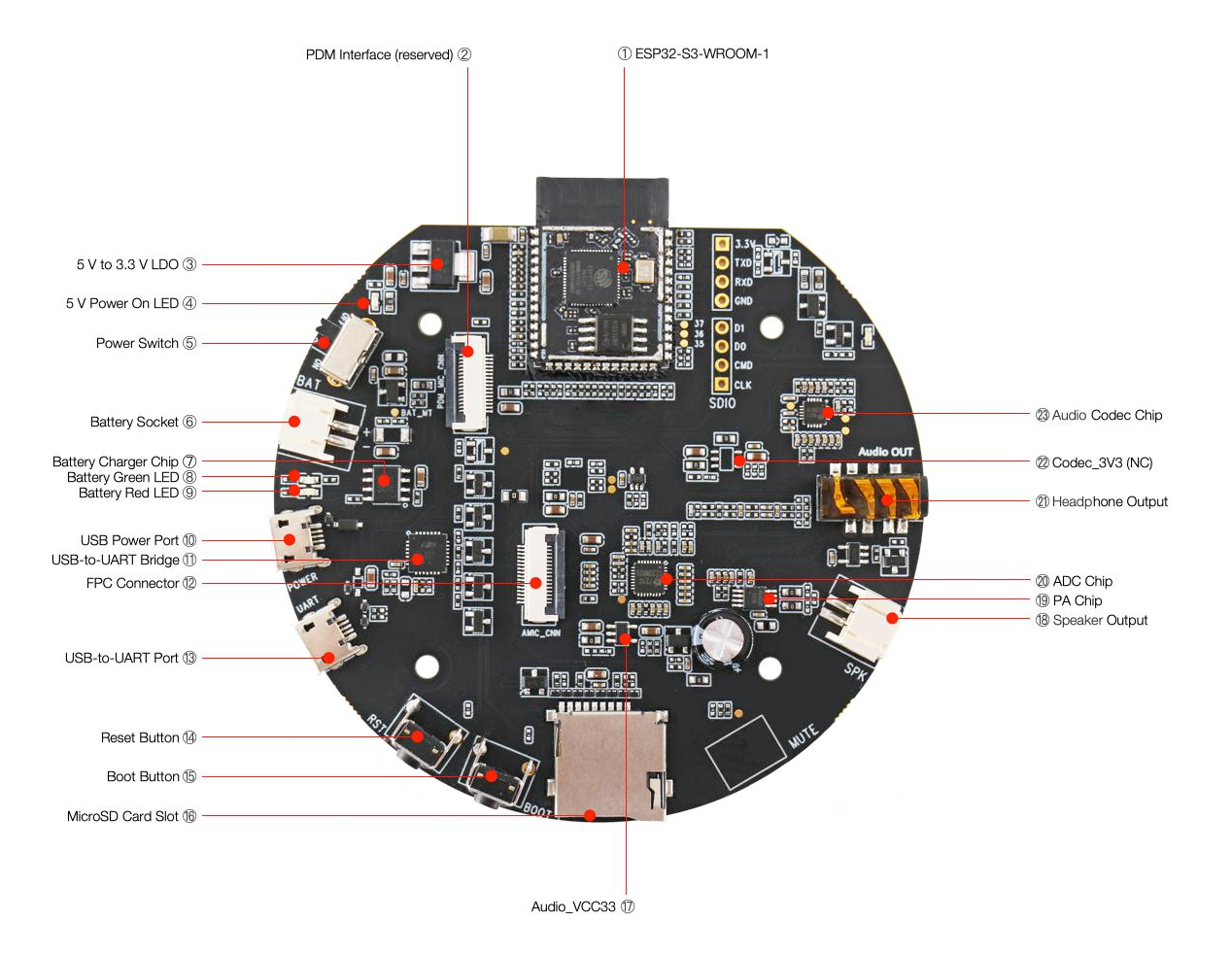
| Pin | GPIO | Labels | Status | Capabilities | Notes |
|---|---|---|---|---|---|
| 1 | - | 3.3V3V3 | power | - | UART/prog header; 3.3V power/reference for serial adapter |
| 2 | 43 | IO43TXD | uart | uart · pwm | UART/prog header; UART0 TX (U0TXD) |
| 3 | 44 | IO44RXD | uart | uart · pwm | UART/prog header; UART0 RX (U0RXD) |
| 4 | - | GND | ground | - | UART/prog header; ground |
| 5 | 37 | IO37 | strapping | pwm | GPIO expansion header (37/36/35) |
| 6 | 36 | IO36 | strapping | pwm | GPIO expansion header (37/36/35) |
| 7 | 35 | IO35 | strapping | pwm | GPIO expansion header (37/36/35) |
| 8 | - | D1 | safe | - | SDIO header; SD/SDIO data line 1 (GPIO not silked) |
| 9 | - | D0 | safe | - | SDIO header; SD/SDIO data line 0 (GPIO not silked) |
| 10 | - | CMD | safe | - | SDIO header; SD/SDIO command line (GPIO not silked) |
| 11 | - | CLK | safe | - | SDIO header; SD/SDIO clock line (GPIO not silked) |
Fine - with a little care
2 pins · 2 things to knowIO43 UART0 transmit pin (U0TXD), default serial console TX UART
Used for bootloader output and UART console logs. If repurposed, you will lose the default serial output (and programming via UART0).
IO44 UART0 receive pin (U0RXD), default serial console RX UART
Used for bootloader input (download mode via serial). If repurposed, you cannot use the default UART0 download mode for programming the chip.
Only if you know the tricks
3 pins · 1 thing to knowIO37IO36IO35 Octal (8-line) flash/PSRAM data and strobe lines on R8/R16V modules; free on quad-PSRAM and PSRAM-less parts Flash
The datasheet keeps GPIO33-37 for "the higher 4 bits data line interface and DQS interface for the SPI0/1 interface in 8-line SPI mode", so octal-PSRAM modules (N16R8 and friends) consume it and do not break it out. On quad-PSRAM or PSRAM-less parts it is an ordinary GPIO - check which variant your module carries.
- IO37Octal (8-line) flash/PSRAM data strobe DQS/DM on R8/R16V modules; free on quad-PSRAM and PSRAM-less parts
- IO36Octal (8-line) flash/PSRAM data line DQ7 on R8/R16V modules; free on quad-PSRAM and PSRAM-less parts
- IO35Octal (8-line) flash/PSRAM data line DQ6 on R8/R16V modules; free on quad-PSRAM and PSRAM-less parts
The Espressif ESP32-S3-Korvo-1 pinout brings out 11 pins - 5 usable GPIO alongside the 3.3V and GND power rails.
On the analog side there are PWM on every GPIO.
2 of the exposed pins carry boot-time or system duties on the ESP32-S3 (IO43 and IO44).
Pinout notes The ESP32-S3-Korvo-1 consists of a main board and a sub-board. The main board integrates the ESP32-S3-WROOM-1 module, function buttons, an SD card slot, a…
Getting started
flash your first firmware in ~2 minutesBoard: ESP32S3 Dev Module Flash Size: 16MB (128Mb) Flash Mode: DIO PSRAM: OPI PSRAM Partition Scheme: 16M Flash (3MB APP/9.9MB FATFS) Upload Speed: 921600
// toggle GPIO8 - wire an LED and resistor to it
void setup() {
  pinMode(8, OUTPUT);
}
void loop() {
  digitalWrite(8, HIGH); delay(500);
  digitalWrite(8, LOW);  delay(500);
}[env:esp32-s3-korvo-1]
platform = espressif32
board = esp32-s3-devkitc-1
framework = arduino
monitor_speed = 115200
upload_speed = 921600
board_build.arduino.memory_type = qio_opi
build_flags = -DBOARD_HAS_PSRAMesp32-s3-devkitc-1 - or type it after board =.esp32:
board: esp32-s3-devkitc-1
variant: esp32s3
framework:
type: esp-idf
psram:
mode: octal
speed: 80MHz
# blink - GPIO8
output:
- platform: gpio
pin: 8
id: led_out
light:
- platform: binary
name: "LED"
output: led_outesp32-s3-devkitc-1 (same ids as PlatformIO).esptool.py --chip esp32s3 --port /dev/ttyACM0 \
--baud 921600 write_flash 0x0 firmware.bin--port = your /dev/tty* (macOS/Linux) or COMx (Windows).Specifications
ESP32-S3 · vs other ESP32 chips →About this board
At its core is the ESP32-S3 - a dual-core Xtensa with vector extensions suited to AI workloads.
Expect to pay about $50.00 - above the ~$29 typical for ESP32-S3 boards.
Only 5 GPIO are broken out, where most ESP32-S3 boards manage about 22 - worth checking the pinout covers what you need.
Onboard you'll find 8MB (OPI) PSRAM, a microSD slot, a microphone (3-mic array), a speaker connector, an audio codec (ES8311), an amplifier, an addressable RGB LED and Reset/Boot/6x Function buttons.
The ESP32-S3-Korvo-1 is an AI development board produced by Espressif, based on the ESP32-S3 SoC and ESP-Skainet, Espressif's speech recognition SDK. It features a three-microphone array suitable for far-field voice pick-up with low power consumption. The board supports voice wake-up and offline speech command recognition in Chinese and English languages, making it ideal for developing applications such as smart displays, smart plugs, and smart switches.
- ES7210 four-channel audio ADC captures the 3-microphone array
- 3-microphone array with 65 mm spacing for far-field voice pickup
- 3.5 mm stereo headphone output jack
- 3 W mono class-D speaker amplifier (4Ω 3W speaker recommended)
- 12x WS2812C addressable RGB LEDs on the ESP32-Korvo-Mic sub-board
- Two-board design: ESP32-S3-Korvo-1 main board and ESP32-Korvo-Mic sub-board joined by an FPC cable
- ESP32-S3-WROOM-1 (N16R8) module with 16 MB flash and 8 MB octal PSRAM
Where to buy
prices are typical street pricesResources
Similar boards

