
Espressif ESP32-S3-Korvo-2
Feature-rich ESP32-S3 development kit with enhanced audio and display support - perfect for multimedia AIoT applications.

Espressif ESP32-S3-Korvo-2 Pinout
22 pins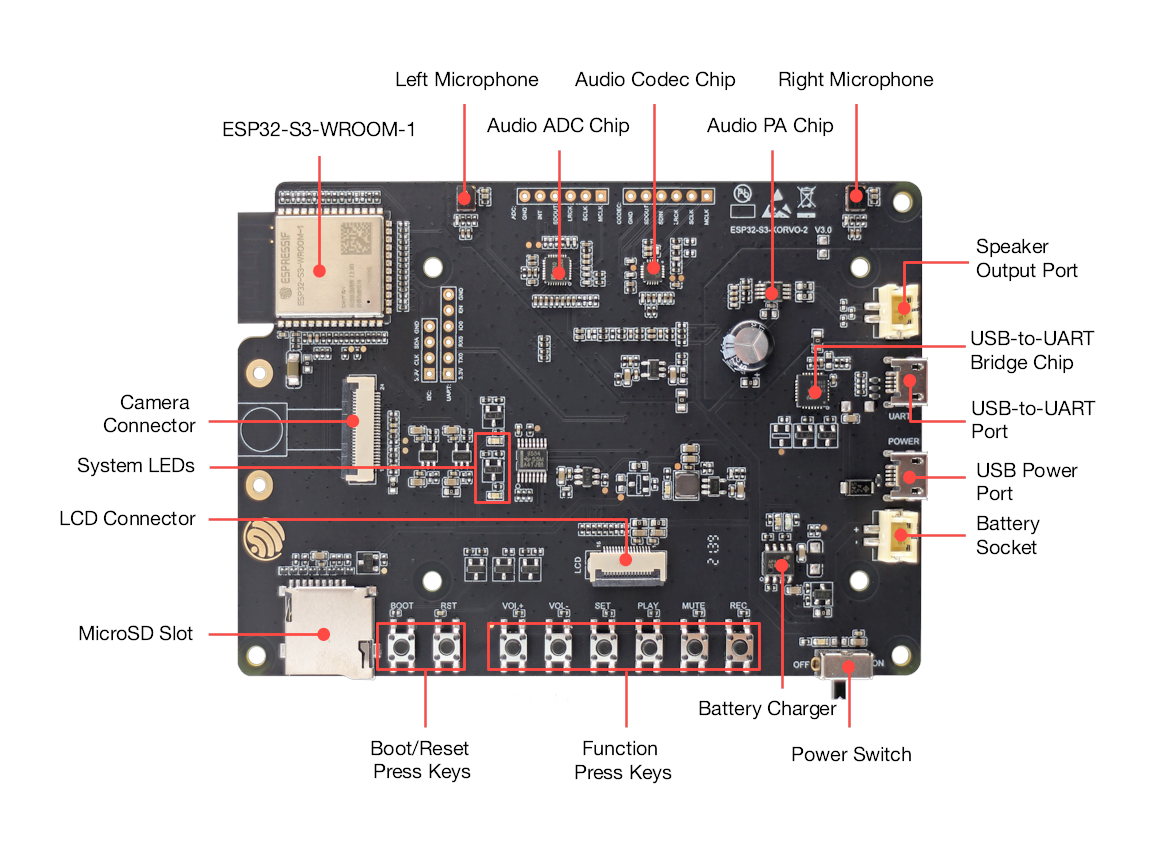
| Pin | GPIO | Labels | Status | Capabilities | Notes |
|---|---|---|---|---|---|
| 1 | - | GND | ground | - | ADC header; ground |
| 2 | - | INT | control | - | ADC header; ES7210 ADC interrupt output |
| 3 | - | SDOUT | safe | - | ADC header; I2S serial data out (ES7210) |
| 4 | - | LRCK | safe | - | ADC header; I2S word/frame clock |
| 5 | - | SCLK | safe | - | ADC header; I2S bit clock |
| 6 | - | MCLK | safe | - | ADC header; I2S master clock |
| 7 | - | GND | ground | - | CODEC header; ground |
| 8 | - | SDOUT | safe | - | CODEC header; I2S serial data out (ES8311) |
| 9 | - | SDIN | safe | - | CODEC header; I2S serial data in (ES8311) |
| 10 | - | LRCK | safe | - | CODEC header; I2S word/frame clock |
| 11 | - | SCLK | safe | - | CODEC header; I2S bit clock |
| 12 | - | MCLK | safe | - | CODEC header; I2S master clock |
| 13 | - | 3V33.3V | power | - | I2C header; 3.3V power |
| 14 | - | CLKSCL | safe | i2c | I2C header; I2C clock (SCL) |
| 15 | - | SDA | safe | i2c | I2C header; I2C data (SDA) |
| 16 | - | GND | ground | - | I2C header; ground |
| 17 | - | 3V33.3V | power | - | UART header; 3.3V power |
| 18 | 43 | IO43TXD0 | uart | uart | UART header; UART0 TX (U0TXD) |
| 19 | 44 | IO44RXD0 | uart | uart | UART header; UART0 RX (U0RXD) |
| 20 | 0 | IO0 | strapping | - | UART header; GPIO0 boot strapping pin |
| 21 | - | ENRST | control | - | UART header; chip enable/reset (active low) |
| 22 | - | GND | ground | - | UART header; ground |
Fine - with a little care
3 pins · 3 things to knowIO43 UART0 transmit pin (U0TXD), default serial console TX UART
Used for bootloader output and UART console logs. If repurposed, you will lose the default serial output (and programming via UART0).
IO44 UART0 receive pin (U0RXD), default serial console RX UART
Used for bootloader input (download mode via serial). If repurposed, you cannot use the default UART0 download mode for programming the chip.
IO0 Bootstrapping pin (Chip boot mode selection) Strapping
Must be pulled high (default) or low (to enter UART download mode) at reset. Using it for other functions can interfere with boot mode configuration.
Across 22 pins, the Espressif ESP32-S3-Korvo-2 exposes 3 GPIO plus GND and 3V3 for power.
3 of the exposed pins carry boot-time or system duties on the ESP32-S3 (IO43, IO44 and IO0) - check the guidance above before wiring anything to them.
Pinout notes The ESP32-S3-Korvo-2 provides access to various GPIOs and communication interfaces. Key components include the ESP32-S3-WROOM-1 module, left and right…
Getting started
flash your first firmware in ~2 minutesBoard: ESP32S3 Dev Module Flash Size: 8MB (64Mb) Flash Mode: DIO PSRAM: OPI PSRAM Partition Scheme: 8M with spiffs (3MB APP/1.5MB SPIFFS) Upload Speed: 921600
// toggle GPIO8 - wire an LED and resistor to it
void setup() {
  pinMode(8, OUTPUT);
}
void loop() {
  digitalWrite(8, HIGH); delay(500);
  digitalWrite(8, LOW);  delay(500);
}[env:esp32-s3-korvo-2]
platform = espressif32
board = esp32-s3-devkitc-1
framework = arduino
monitor_speed = 115200
upload_speed = 921600
board_build.arduino.memory_type = qio_opi
build_flags = -DBOARD_HAS_PSRAMesp32-s3-devkitc-1 - or type it after board =.esp32:
board: esp32-s3-devkitc-1
variant: esp32s3
framework:
type: esp-idf
psram:
mode: octal
speed: 80MHz
# blink - GPIO8
output:
- platform: gpio
pin: 8
id: led_out
light:
- platform: binary
name: "LED"
output: led_outesp32-s3-devkitc-1 (same ids as PlatformIO).esptool.py --chip esp32s3 --port /dev/ttyACM0 \
--baud 921600 write_flash 0x0 firmware.bin--port = your /dev/tty* (macOS/Linux) or COMx (Windows).Specifications
ESP32-S3 · vs other ESP32 chips →About this board
Inside sits the ESP32-S3 - a dual-core Xtensa with vector extensions suited to AI workloads.
At $45.00 it's on the expensive side for an ESP32-S3 board - most land around $29.
Only 3 GPIO are left for your own hardware - the display and onboard peripherals claim the rest.
Around the module: 8MB (OPI) PSRAM, an LCD 2.4" 320x240 display with touch, an OV2640 camera (1600x1200), a microSD slot, a microphone (Dual mic array), a speaker connector, an audio codec (ES8311), an amplifier (NS4150) and REC/MUTE/PLAY/SET/VOL-/VOL+/Boot/Reset buttons.
The ESP32-S3-Korvo-2 is a multimedia development board based on the ESP32-S3 chip. It is equipped with a two-microphone array suitable for voice recognition and near/far-field voice wake-up applications. The board integrates multiple peripherals such as an LCD, camera, and microSD card, and supports JPEG video stream processing. It is ideal for developing low-cost and low-power network-connected audio and video products.
- ES7210 4-channel audio ADC for the two-microphone array
- ESP32-S3-WROOM-1-N8R8 module (8MB flash + 8MB octal PSRAM)
Where to buy
prices are typical street pricesResources
Similar boards

