
LilyGo T-Deck Plus
An enhanced version of the T-Deck, featuring additional modules like GPS and LoRa for advanced applications.

LilyGo T-Deck Plus Pinout
4 pins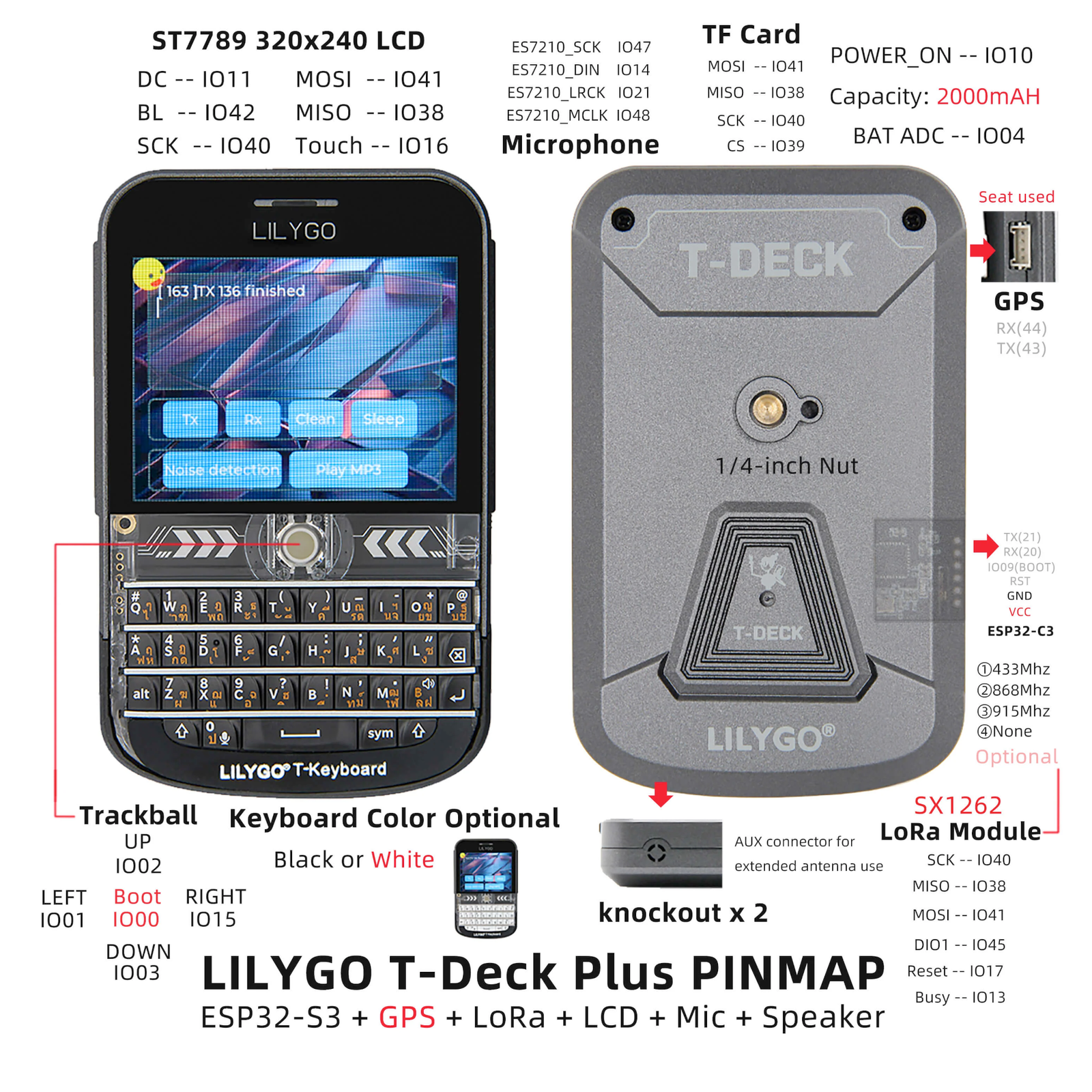
| Pin | GPIO | Labels | Status | Capabilities | Notes |
|---|---|---|---|---|---|
| 1 | - | 3V33.3V | power | - | 3.3V rail on the 4-pin Grove (HY2.0) connector. On the T-Deck Plus this Grove port is dedicated to the onboard u-blox MIA-M10Q GPS (data lines IO43 TX / IO44 RX, Serial1) and is not free for general use. |
| 2 | - | GND | ground | - | Ground on the 4-pin Grove connector (shared with the onboard GPS). |
| 3 | 43 | TXIO43GPIO43 | uart | uart | Grove UART TX (Serial1) - wired to the onboard u-blox MIA-M10Q GPS RX; not free for general use on the Plus. |
| 4 | 44 | RXIO44GPIO44 | uart | uart | Grove UART RX (Serial1) - wired to the onboard u-blox MIA-M10Q GPS TX; not free for general use on the Plus. |
Fine - with a little care
2 pins · 2 things to knowTXGPIO43 UART0 transmit pin (U0TXD), default serial console TX UART
Used for bootloader output and UART console logs. If repurposed, you will lose the default serial output (and programming via UART0).
RXGPIO44 UART0 receive pin (U0RXD), default serial console RX UART
Used for bootloader input (download mode via serial). If repurposed, you cannot use the default UART0 download mode for programming the chip.
The LilyGo T-Deck Plus breaks out 4 pins in total: 2 GPIO for your project, with 3V3 and GND handling power.
For peripherals, TX/RX on GPIO43 and GPIO44 cover serial logging and flashing.
2 of the exposed pins carry boot-time or system duties on the ESP32-S3 (TX and RX).
Getting started
flash your first firmware in ~2 minutesBoard: ESP32S3 Dev Module USB CDC On Boot: Enabled Flash Size: 16MB (128Mb) Flash Mode: DIO PSRAM: OPI PSRAM Partition Scheme: 16M Flash (3MB APP/9.9MB FATFS) Upload Speed: 921600
// toggle GPIO8 - wire an LED and resistor to it
void setup() {
  pinMode(8, OUTPUT);
}
void loop() {
  digitalWrite(8, HIGH); delay(500);
  digitalWrite(8, LOW);  delay(500);
}[env:lilygo_t_deck_plus]
platform = espressif32
board = esp32-s3-devkitc-1
framework = arduino
monitor_speed = 115200
upload_speed = 921600
board_build.arduino.memory_type = qio_opi
build_flags = -DBOARD_HAS_PSRAMesp32-s3-devkitc-1 - or type it after board =.esp32:
board: esp32-s3-devkitc-1
variant: esp32s3
framework:
type: esp-idf
psram:
mode: octal
speed: 80MHz
# blink - GPIO8
output:
- platform: gpio
pin: 8
id: led_out
light:
- platform: binary
name: "LED"
output: led_outesp32-s3-devkitc-1 (same ids as PlatformIO).esptool.py --chip esp32s3 --port /dev/ttyACM0 \
--baud 921600 write_flash 0x0 firmware.bin--port = your /dev/tty* (macOS/Linux) or COMx (Windows).Specifications
ESP32-S3 · 120 × 68 mm · vs other ESP32 chips →Dimensions
About this board
At its core is the ESP32-S3 - a dual-core Xtensa with vector extensions suited to AI workloads.
Expect to pay about $70.99 - above the ~$29 typical for ESP32-S3 boards.
Only 2 GPIO are left for your own hardware - the display and onboard peripherals claim the rest.
Onboard you'll find 8MB (OPI) PSRAM, an IPS LCD 2.8" 320x240 display with touch, a microSD slot, LoRa (SX1262), GPS (u-blox MIA-M10Q), a microphone (Dual MEMS array), a speaker, an audio codec (ES7210), an amplifier (MAX98357A), battery charging (TP4065B) via JST 1.25 and Reset/Boot buttons.
It flashes over native USB - no serial-converter driver needed, which isn't a given among ESP32-S3 boards.
The LilyGo T-Deck Plus 1 is an advanced ESP32-S3-based development board designed for versatile applications. Featuring integrated WiFi and Bluetooth 5, it offers seamless connectivity for IoT and embedded projects.
The T-Deck Plus 1 includes a 2.8-inch IPS LCD display with touch support, making it ideal for graphical user interfaces. It also comes with 8MB PSRAM and 16MB Flash for enhanced performance.
With multiple GPIOs, ADC, PWM, I2C, SPI, and a built-in keyboard, it is perfect for handheld devices and portable applications.
- BlackBerry-style backlit QWERTY keyboard (managed by an onboard ESP32-C3 over I2C)
- Trackball navigation module with center-press button
- LoRa SX1262 selectable 433 / 868 / 915 MHz, +22 dBm, u.FL antenna
- Onboard u-blox MIA-M10Q GNSS module (Quectel L76K on some units)
- 2000 mAh built-in LiPo battery with TP4065B charger IC
- ES7210 codec with a dual MEMS microphone array and MAX98357A speaker amplifier
Where to buy
prices are typical street pricesResources
Similar boards

