
LilyGo T-Deck
A compact device featuring a 2.8-inch IPS LCD touch screen, mini keyboard, and ESP32-S3 processor, suitable for portable applications.

LilyGo T-Deck Pinout
4 pins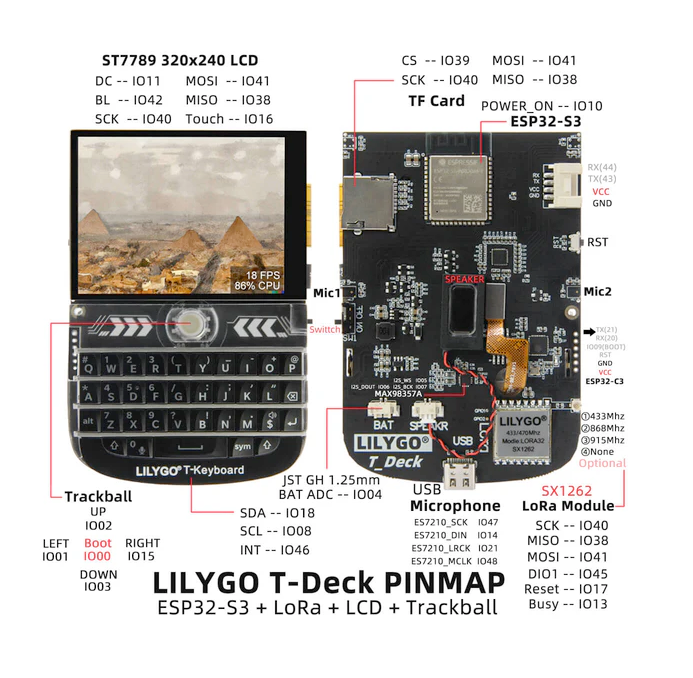
| Pin | GPIO | Labels | Status | Capabilities | Notes |
|---|---|---|---|---|---|
| 1 | - | 3V3VCC | power | - | Grove HY2.0-4P I2C connector - 3.3V supply |
| 2 | - | GND | ground | - | Grove HY2.0-4P I2C connector - ground |
| 3 | 18 | SDAIO18GPIO18 | safe | i2c | Grove I2C SDA - shared bus with GT911 touch and keyboard MCU (0x55) |
| 4 | 8 | SCLIO8GPIO8 | safe | i2c | Grove I2C SCL - shared bus with GT911 touch and keyboard MCU (0x55) |
Start with these
2 pins with no boot or system involvementFreely assignable - no strapping, flash, USB or JTAG duties. Ideal first picks for buttons, sensors and LEDs.
The LilyGo T-Deck pinout brings out 4 pins - 2 usable GPIO alongside the 3V3 and GND power rails.
Peripheral wiring is straightforward: I²C is mapped to SDA on GPIO18 and SCL on GPIO8.
SDA and SCL are free of any such role - the safest first picks.
Pinout notes The LilyGo T-Deck is a highly-integrated handheld: almost every ESP32-S3 GPIO is committed on-board to the ST7789 display, GT911 touch, SX1262 LoRa, microSD,…
The LilyGo T-Deck is a highly-integrated handheld: almost every ESP32-S3 GPIO is committed on-board to the ST7789 display, GT911 touch, SX1262 LoRa, microSD, trackball, I2S speaker amp and the QWERTY keyboard MCU. As a result it exposes essentially one user-wirable connector rather than a broad GPIO header.
The single Grove HY2.0-4P I²C connector breaks out the shared I²C bus - SDA on GPIO18 and SCL on GPIO8 - plus 3V3 and GND. This is the same bus used internally by the touch panel and the keyboard controller (address 0x55).
Getting started
flash your first firmware in ~2 minutesBoard: ESP32S3 Dev Module USB CDC On Boot: Enabled Flash Size: 16MB (128Mb) Flash Mode: DIO PSRAM: OPI PSRAM Partition Scheme: 16M Flash (3MB APP/9.9MB FATFS) Upload Speed: 921600
// toggle GPIO18 - wire an LED and resistor to it
void setup() {
  pinMode(18, OUTPUT);
}
void loop() {
  digitalWrite(18, HIGH); delay(500);
  digitalWrite(18, LOW);  delay(500);
}[env:lilygo_t_deck]
platform = espressif32
board = esp32-s3-devkitc-1
framework = arduino
monitor_speed = 115200
upload_speed = 921600
board_build.arduino.memory_type = qio_opi
build_flags = -DBOARD_HAS_PSRAMesp32-s3-devkitc-1 - or type it after board =.esp32:
board: esp32-s3-devkitc-1
variant: esp32s3
framework:
type: esp-idf
psram:
mode: octal
speed: 80MHz
# blink - GPIO18
output:
- platform: gpio
pin: 18
id: led_out
light:
- platform: binary
name: "LED"
output: led_outesp32-s3-devkitc-1 (same ids as PlatformIO).esptool.py --chip esp32s3 --port /dev/ttyACM0 \
--baud 921600 write_flash 0x0 firmware.bin--port = your /dev/tty* (macOS/Linux) or COMx (Windows).Specifications
ESP32-S3 · 100 × 68 mm · vs other ESP32 chips →Dimensions
About this board
Inside sits the ESP32-S3 - a dual-core Xtensa with vector extensions suited to AI workloads.
At $60.00 it's on the expensive side for an ESP32-S3 board - most land around $29.
Only 2 GPIO are left for your own hardware - the display and onboard peripherals claim the rest.
Around the module: 8MB (OPI) PSRAM, an IPS LCD 2.8" 320x240 display with touch, a microSD slot, LoRa (SX1262), a microphone, a speaker and battery charging via JST 1.25.
It flashes over native USB - no serial-converter driver needed, which isn't a given among ESP32-S3 boards.
The LilyGo T-Deck is a versatile development device featuring an ESP32-S3FN16R8 dual-core processor with integrated Wi-Fi and Bluetooth 5 (LE). It boasts a 2.8-inch IPS LCD (320x240) touch screen, a mini keyboard, and a trackball, making it ideal for portable applications.
With support for LoRa transceiver (SX1262) at various frequencies (433/868/915 MHz), it enables long-range communication for IoT projects. The device comes with 16MB Flash and 8MB PSRAM, providing ample memory for complex applications.
Additional features include a microphone, speaker, and optional GPS module, enhancing its functionality for diverse use cases.
- BlackBerry-style backlit QWERTY keyboard (managed by an onboard ESP32-C3 over I2C)
- Trackball navigation module
- LoRa SX1262 selectable 433 / 868 / 915 MHz, +22 dBm, u.FL antenna
- Optional GPS module (standard on the T-Deck Plus variant)
- Grove HY2.0-4P I2C expansion connector
Where to buy
prices are typical street pricesResources
Similar boards

