
KY-024 Linear Magnetic Hall Sensor Module
The KY-024 is a linear magnetic Hall sensor module that provides both analog and digital outputs. It is equipped with a potentiometer to adjust sensitivity and is suitable for detecting magnetic fields in various applications.

KY-024 pinout
The KY-024 is a 4-pin linear magnetic Hall sensor module with dual outputs:
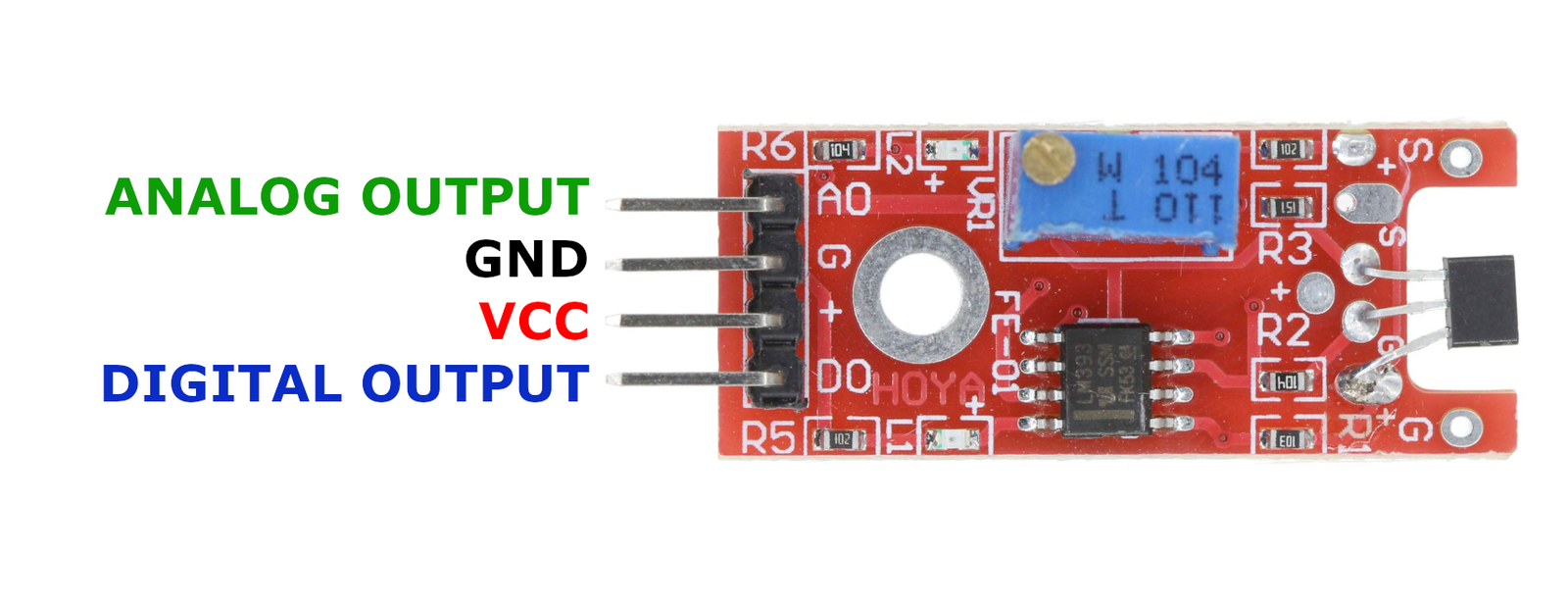
| Pin | Type | Description | Notes |
|---|---|---|---|
| GND | Power | Ground connection | |
| +V | Power | Power supply | 3.3V or 5V |
| D0 | Communication | Digital output | HIGH when magnetic field exceeds threshold |
| A0 | Communication | Analog output | Voltage proportional to magnetic field strength |
Interface: Dual output (analog + digital with comparator)
Sensor: Linear Hall effect sensor
Analog Output: Continuous voltage reading proportional to field strength
Digital Output: Threshold-based trigger (adjustable via potentiometer)
Power: 3.3V or 5V operation
Applications: Speed sensing, position detection, magnetic field measurement, proximity detection
Wiring the KY-024 to ESP32
To interface the KY-024 with an ESP32 for magnetic field detection:
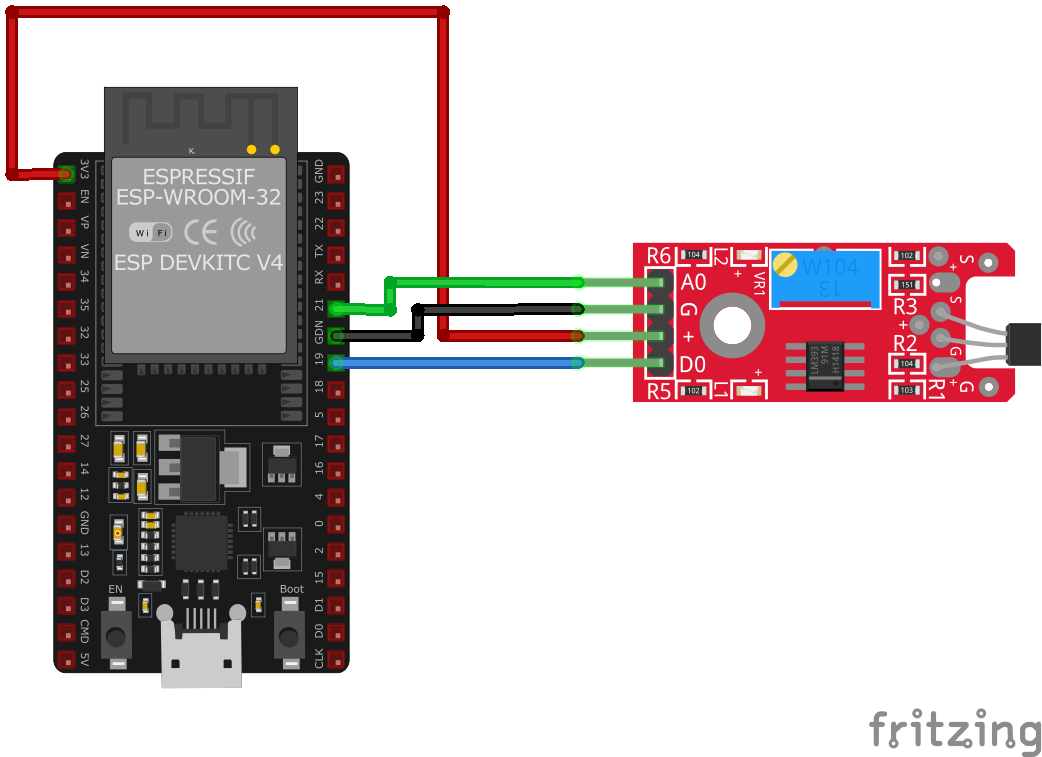
| KY-024 pin | ESP32 pin | Purpose |
|---|---|---|
| GND | GND | Ground |
| +V | 3.3V or 5V | Power supply |
| D0 | GPIO17 | Digital input (any GPIO) · optional |
| A0 | GPIO36 | Analog input (ADC pin) · optional |
Dual Use: Use analog for precise field strength or digital for threshold detection
ADC Pins: Use GPIO32-39 for analog input on ESP32
Voltage: 3.3V recommended for ESP32 ADC compatibility
Adjustment: Turn onboard potentiometer to set digital trigger threshold
Linear: Output voltage varies proportionally with magnetic field strength
KY-024 code examples
// Declaration and initialization of the input pins
int analog_input = 36;  // Analog output of the sensor (GPIO36, matches the wiring above)
int digital_input = 17; // Digital output of the sensor (GPIO17)

void setup() {
    pinMode(digital_input, INPUT);
    Serial.begin(115200);
    Serial.println("KY-024 Magnetic field detection");
}

void loop() {
    // Read current values and convert to voltage (ESP32: 12-bit ADC, 3.3V)
    float analog_value = analogRead(analog_input) * (3.3 / 4095.0);
    int digital_value = digitalRead(digital_input);

    Serial.print("Analog voltage value: ");
    Serial.print(analog_value, 4);
    Serial.print(" V, 	 Threshold value: ");

    if (digital_value == 1) {
        Serial.println("reached");
    } else {
        Serial.println("not reached");
    }
    Serial.println("-------------------------------");
    delay(1000);
}
This Arduino code reads the analog voltage from the KY-024 sensor's analog output and checks the digital output to determine if the magnetic field strength has surpassed the set threshold. The results are printed to the serial monitor every second.
#include <stdio.h>
#include "freertos/FreeRTOS.h"
#include "freertos/task.h"
#include "driver/adc.h"
#include "driver/gpio.h"

#define HALL_SENSOR_ANALOG_PIN ADC1_CHANNEL_0 // GPIO36
#define HALL_SENSOR_DIGITAL_PIN GPIO_NUM_17

void app_main(void) {
    adc1_config_width(ADC_WIDTH_BIT_12);
    adc1_config_channel_atten(HALL_SENSOR_ANALOG_PIN, ADC_ATTEN_DB_11);
    gpio_set_direction(HALL_SENSOR_DIGITAL_PIN, GPIO_MODE_INPUT);

    printf("KY-024 Magnetic Field Detection\n");
    while (1) {
        int analog_value = adc1_get_raw(HALL_SENSOR_ANALOG_PIN);
        int digital_value = gpio_get_level(HALL_SENSOR_DIGITAL_PIN);
        printf("Analog Value: %d, Digital Threshold: %s\n", analog_value, digital_value ? "Reached" : "Not Reached");
        vTaskDelay(pdMS_TO_TICKS(1000));
    }
}
This ESP-IDF code reads the analog value from the KY-024 sensor using ADC on GPIO36 and monitors the digital output on GPIO17 to determine if the magnetic field threshold is exceeded. The results are printed every second.
sensor:
  - platform: adc
    pin: GPIO36
    name: "KY-024 Magnetic Field Strength"
    update_interval: 1s
binary_sensor:
  - platform: gpio
    pin:
      number: GPIO17
      mode: INPUT_PULLUP
    name: "KY-024 Magnetic Threshold Trigger"
This ESPHome configuration reads the KY-024 sensor's analog output on GPIO36 and detects the threshold trigger using GPIO17 as a binary sensor. Updates are logged every second.
[env:esp32]
platform = espressif32
board = esp32dev
framework = arduino#include <Arduino.h>
#define HALL_SENSOR_ANALOG_PIN A0
#define HALL_SENSOR_DIGITAL_PIN 17
void setup() {
pinMode(HALL_SENSOR_DIGITAL_PIN, INPUT);
Serial.begin(115200);
Serial.println("KY-024 Magnetic Sensor Test");
}
void loop() {
int analog_value = analogRead(HALL_SENSOR_ANALOG_PIN);
int digital_value = digitalRead(HALL_SENSOR_DIGITAL_PIN);
Serial.printf("Analog: %d, Digital: %s\n", analog_value, digital_value ? "Threshold Reached" : "Not Reached");
delay(1000);
}This PlatformIO code reads the KY-024 sensor's analog output and monitors the digital threshold trigger. The values are printed every second.
import machine
import time

HALL_SENSOR_ANALOG_PIN = machine.ADC(machine.Pin(36))
HALL_SENSOR_ANALOG_PIN.atten(machine.ADC.ATTN_11DB)
HALL_SENSOR_DIGITAL_PIN = machine.Pin(17, machine.Pin.IN, machine.Pin.PULL_UP)

while True:
    analog_value = HALL_SENSOR_ANALOG_PIN.read()
    digital_value = HALL_SENSOR_DIGITAL_PIN.value()
    print("Analog:", analog_value, "Digital:", "Threshold Reached" if digital_value else "Not Reached")
    time.sleep(1)
This MicroPython script reads the KY-024 sensor's analog signal using ADC on GPIO36 and monitors the digital output on GPIO17. The readings are printed every second.
KY-024 specifications
About the KY-024
The KY-024 is built around a 49E-family linear Hall-effect sensor (an SS49E/AH49E-type part, per multiple teardown sources) paired with an LM393 comparator and a trim potentiometer on a 4-pin board - a genuinely different chip from the KY-003’s digital-only A3144. “Linear” is the key word: the analog output tracks field strength and polarity continuously, sitting near half the supply voltage with no magnet present and swinging up or down depending on which pole approaches, rather than just snapping between two states.
The digital pin on the same board is just that analog signal run through the comparator against whatever threshold the trim pot is set to - convenient for a simple on/off trigger, but it throws away the information the analog pin actually has. For pure presence/absence detection with fewer parts and no potentiometer to tune, the KY-003 does the same job with less hardware; keep the KY-024 for projects that actually want a graded field-strength reading, and put the analog output on an ESP32 ADC1 pin (GPIO32-39) to get it.
KY-024 troubleshooting
No Response from Sensor
›
Issue: The sensor does not provide any output when exposed to a magnetic field.
Solutions:
- Verify all connections are secure and correctly placed.
- Ensure the module is receiving the appropriate voltage (3.3V or 5V).
- Adjust the potentiometer to set the correct sensitivity threshold.
- Test the sensor with a known magnetic source to confirm functionality.
Unstable Analog Readings
›
Issue: The analog output fluctuates without any change in the magnetic field.
Solutions:
- Check for electromagnetic interference from nearby devices.
- Ensure that the power supply is stable and free from noise.
- Use shielded cables for analog signal transmission if necessary.
Where to buy the KY-024

Resources
Similar sensors


