
KY-052 Pressure and Temperature Sensor Module
The KY-052 module features the BMP280 sensor, offering accurate measurements of barometric pressure and temperature. It utilizes the <strong>I2C interface</strong> for communication, making it ideal for environmental monitoring projects.

KY-052 pinout
The KY-052 is a 6-pin barometric pressure and temperature sensor module:
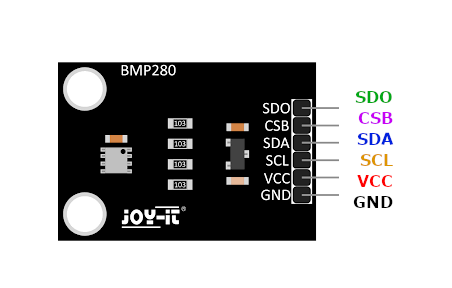
| Pin | Type | Description | Notes |
|---|---|---|---|
| GND | Power | Ground connection | |
| VCC | Power | Power supply | 3.3V or 5V |
| SDA | Communication | I2C data line | Bidirectional data |
| SCL | Communication | I2C clock line | Clock signal |
| CSB | Communication | Chip select for SPI | Connect to VCC for I2C mode |
| SDO | Communication | SPI data output | Not used in I2C mode |
Interface: I2C (default) or SPI
Sensor: BMP280 barometric pressure and temperature sensor
I2C Address: 0x76 (SDO to GND) or 0x77 (SDO to VCC)
Power: 3.3V or 5V operation (onboard voltage regulator)
Pressure Range: 300-1100 hPa (±9000m to -500m altitude)
Temperature Range: -40°C to +85°C
Pressure Accuracy: ±1 hPa (±8m altitude)
Applications: Weather stations, altimeters, GPS enhancement, indoor navigation
Wiring the KY-052 to ESP32
To interface the KY-052 with an ESP32 for pressure/temperature sensing (I2C mode):
| KY-052 pin | ESP32 pin | Purpose |
|---|---|---|
| GND | GND | Ground |
| VCC | 3.3V or 5V | Power supply |
| SDA | GPIO21 | I2C data (default ESP32 I2C SDA) |
| SCL | GPIO22 | I2C clock (default ESP32 I2C SCL) |
| CSB | VCC | Connect to VCC for I2C mode |
| SDO | NC or GND/VCC | Leave NC, or connect to GND (0x76) or VCC (0x77) for address · optional |
I2C Mode: Connect CSB to VCC to enable I2C communication
I2C Address: 0x76 (default) or 0x77 (connect SDO to VCC)
Voltage: 3.3V recommended for ESP32, but 5V compatible
Pull-ups: Internal I2C pull-ups on module (2.2kΩ typical)
Altitude: Calculate altitude from pressure using barometric formula
Temperature: Built-in temperature compensation for accurate pressure readings
SPI Mode: If using SPI, connect CSB to GPIO (CS), SCL to SCK, SDA to MOSI, SDO to MISO
Power: ~2.7μA sleep, 720μA active (very low power)
KY-052 code examples
#include <Wire.h>
#include <Adafruit_BMP280.h>

Adafruit_BMP280 bmp;

void setup() {
    Serial.begin(9600);
    if (!bmp.begin()) {
        Serial.println(F("Could not find a valid BMP280 sensor, check wiring!"));
        while (1);
    }
}

void loop() {
    Serial.print(F("Temperature = "));
    Serial.print(bmp.readTemperature());
    Serial.println(" °C");

    Serial.print(F("Pressure = "));
    Serial.print(bmp.readPressure());
    Serial.println(" Pa");

    Serial.print(F("Altitude = "));
    Serial.print(bmp.readAltitude(1013.25)); // Adjust to local sea level pressure
    Serial.println(" m");

    delay(2000);
}
This Arduino code initializes the BMP280 sensor and reads temperature, pressure, and altitude data. The altitude calculation requires adjusting the sea level pressure value (1013.25 hPa) to your local value for accurate readings. The sensor data is printed to the serial monitor every 2 seconds.
// Requires the esp-idf-lib BMP280 driver from the ESP Component Registry:
// idf.py add-dependency "esp-idf-lib/bmp280^1.0.7"
#include <stdio.h>
#include <string.h>
#include "freertos/FreeRTOS.h"
#include "freertos/task.h"
#include "bmp280.h"
#define SDA_GPIO GPIO_NUM_21
#define SCL_GPIO GPIO_NUM_22
void app_main(void)
{
ESP_ERROR_CHECK(i2cdev_init());
bmp280_params_t params;
bmp280_init_default_params(¶ms);
bmp280_t dev;
memset(&dev, 0, sizeof(bmp280_t));
ESP_ERROR_CHECK(bmp280_init_desc(&dev, BMP280_I2C_ADDRESS_0, 0, SDA_GPIO, SCL_GPIO));
ESP_ERROR_CHECK(bmp280_init(&dev, ¶ms));
float pressure, temperature;
while (1) {
if (bmp280_read_float(&dev, &temperature, &pressure, NULL) == ESP_OK)
printf("Temp %.2f C, Press %.2f Pa\n", temperature, pressure);
else
printf("Could not read data from sensor\n");
vTaskDelay(pdMS_TO_TICKS(2000));
}
}ESP-IDF ships no BMP280 driver of its own, so this example uses the maintained esp-idf-lib BMP280 driver from the ESP Component Registry. Install it into your project first with idf.py add-dependency "esp-idf-lib/bmp280^1.0.7", then build as usual.
i2cdev_init() sets up the shared I2C layer used by all esp-idf-lib drivers, and bmp280_read_float() returns temperature in Celsius and pressure in Pascal every 2 seconds. The humidity argument is NULL because the KY-052's BMP280 has no humidity sensor (the same driver also supports the BME280, which does). Wire SDA to GPIO 21 and SCL to GPIO 22, or change the defines.
i2c:
  sda: GPIO21
  scl: GPIO22

sensor:
  - platform: bmp280_i2c
    temperature:
      name: "KY-052 Temperature"
    pressure:
      name: "KY-052 Pressure"
    address: 0x76
    update_interval: 2s
Since ESPHome 2023.12 the BMP280 platform is split by bus - bmp280_i2c here, with the KY-052 at address 0x76 on the default I2C pins. Temperature and pressure each become their own entity.
[env:esp32]
platform = espressif32
board = esp32dev
framework = arduino
lib_deps =
    adafruit/Adafruit BMP280 Library
adafruit/Adafruit Unified Sensor#include <Arduino.h>
#include <Wire.h>
#include <Adafruit_BMP280.h>
Adafruit_BMP280 bmp;
void setup() {
Serial.begin(115200);
if (!bmp.begin(0x76)) {
Serial.println("Could not find a valid BMP280 sensor, check wiring!");
while (1);
}
}
void loop() {
Serial.print("Temperature = ");
Serial.print(bmp.readTemperature());
Serial.println(" °C");
Serial.print("Pressure = ");
Serial.print(bmp.readPressure() / 100.0);
Serial.println(" hPa");
Serial.print("Altitude = ");
Serial.print(bmp.readAltitude(1013.25)); // Adjust sea level pressure
Serial.println(" m");
delay(2000);
}This PlatformIO code configures the KY-052 sensor (BMP280) for temperature, pressure, and altitude measurement using I2C communication. It reads data every 2 seconds and prints it to the serial monitor.
# Requires driver: bmp280.py from https://github.com/dafvid/micropython-bmp280
# Copy it to the board: mpremote cp bmp280.py :
from time import sleep
from machine import I2C, Pin
from bmp280 import BMP280

# Initialize I2C (SDA=GPIO21, SCL=GPIO22)
i2c = I2C(0, scl=Pin(22), sda=Pin(21))

# Initialize KY-052 (BMP280, address 0x76)
bmp = BMP280(i2c)

while True:
    print("KY-052 Temperature: {:.2f} C".format(bmp.temperature))
    print("Pressure: {:.2f} hPa".format(bmp.pressure / 100))
    sleep(2)
The example uses dafvid/micropython-bmp280 (copy bmp280.py to the board with mpremote) for the KY-052's BMP280. The driver exposes temperature (Celsius) and pressure (Pascal - divided by 100 to print hPa); it has no altitude property, but you can derive altitude from pressure with the barometric formula if needed.
KY-052 specifications
About the KY-052
The KY-052 is a breakout for Bosch’s BMP280 - the exact same chip, so any library or example written for a bare BMP280 board works here unchanged. The CSB pin is what picks the interface at power-up: tied to VCC it puts the chip in I2C mode at address 0x76 (or 0x77 with SDO pulled to VCC instead of GND), left floating or pulled low it switches the same chip into SPI, using SCL as the clock and SDA/SDO as the data lines - one sensor, two wiring options depending on what the rest of the project already uses.
What the BMP280 does not have is a humidity element, so this module reads pressure and temperature only, with pressure the more interesting of the two given its 300 to 1100 hPa range and roughly 1 hPa absolute accuracy translating to about 8 meters of altitude resolution. Projects that also want humidity from the same Bosch sensor family, weather stations especially, are better served by the BME280, which is pin- and protocol-compatible but adds a humidity element the BMP280 simply does not have.
KY-052 troubleshooting
Sensor Not Responding
›
Issue: The sensor does not provide any data.
Solutions:
- Ensure proper wiring connections, especially the I2C lines (SDA and SCL).
- Verify that the CSB pin is connected to VCC to enable I2C mode.
- Check that the correct I2C address is used in the code (default is 0x76 or 0x77).
Incorrect Temperature or Pressure Readings
›
Issue: The sensor outputs inaccurate environmental data.
Solutions:
- Ensure the sensor is not exposed to rapid temperature changes or drafts.
- Calibrate the sensor if necessary, especially for altitude measurements.
- Verify that the sensor is operating within its specified temperature range (-40°C to +85°C).
Resources
Similar sensors


