
Adafruit QT Py ESP32-C3
Small ESP32-C3 board with STEMMA QT - perfect for plug-and-play sensor projects and low-power wireless apps.

Pinout
13 pins · 2.54 mm pitch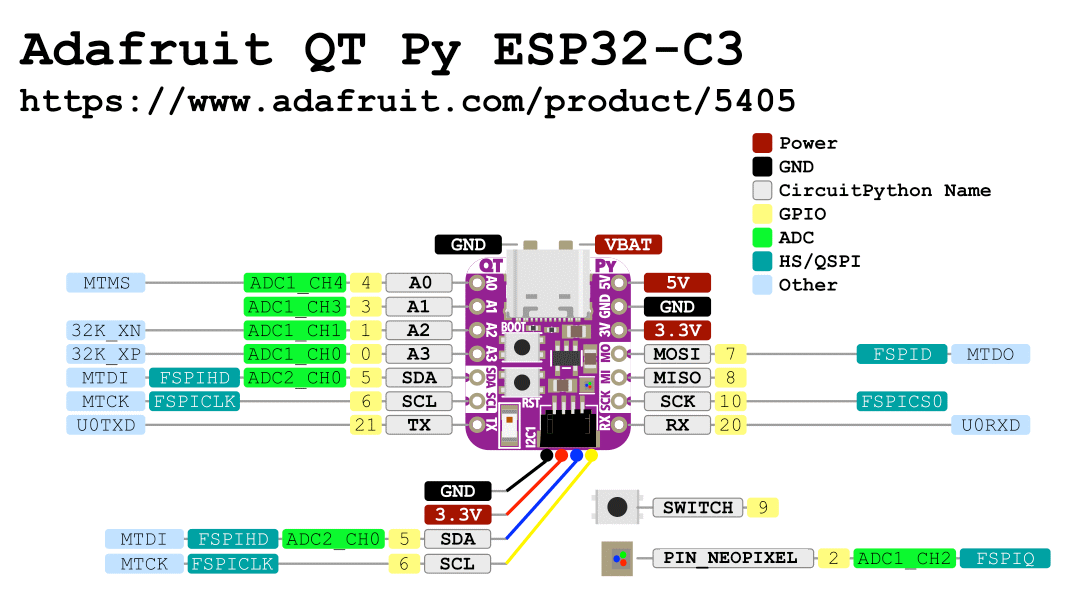
| Pin | GPIO | Labels | Status | Capabilities | Notes |
|---|---|---|---|---|---|
| 1 | 0 | A3 | safe | adc | |
| 2 | 1 | A2 | safe | adc | |
| 3 | 2 | PIN_NEOPIXEL | strapping | - | |
| 4 | 3 | A1 | safe | adc | |
| 5 | 4 | A0 | strapping | adc | |
| 6 | 5 | SDAA4 | strapping | adc · i2c | |
| 7 | 6 | SCLSS | strapping | spi · i2c | |
| 8 | 7 | MOSI | strapping | spi | |
| 9 | 8 | MISO | strapping | spi | |
| 10 | 9 | BUTTON | strapping | - | |
| 11 | 10 | SCK | safe | spi | |
| 12 | 20 | RX | uart | uart | |
| 13 | 21 | TX | uart | uart |
Start with these
4 pins with no boot or system involvementFreely assignable - no strapping, flash, USB or JTAG duties. Ideal first picks for buttons, sensors and LEDs.
Fine - with a little care
sampled at boot or shared with debug/serial| Pin | Label | What to know | Role |
|---|---|---|---|
| PIN_NEOPIXEL | GPIO2 | Must be held high during boot (if low on reset, normal flash boot may fail) | Strapping |
| A0 | MTMS | Used during boot; JTAG TMS for debugging; acts as Quad-SPI flash IO (hold data line) in internal-flash variants | JTAG |
| SDA | MTDI | Used during boot; JTAG TDI for debugging; acts as Quad-SPI flash IO (write-protect data line) in internal-flash variants | JTAG |
| SCL | MTCK | Used during boot; JTAG TCK for debugging; provides flash clock in internal-flash variants | JTAG |
| MOSI | MTDO | Used during boot; JTAG TDO for debugging; acts as Quad-SPI flash IO (data line) in internal-flash variants | JTAG |
| MISO | GPIO8 | Must be held high during reset (if low, UART flashing/boot may not work) | Strapping |
| BUTTON | GPIO9 | Controls boot mode on reset (HIGH for normal flash boot, LOW enters serial download mode) | Strapping |
| RX | U0RXD | Used as UART0 receive (console/bootloader); repurposing may disable serial programming and debug logs | UART |
| TX | U0TXD | Used as UART0 transmit (console/bootloader); repurposing may disable serial console output and printing | UART |
Pinout notes All 13 pins on the Adafruit QT Py ESP32-C3 are usable GPIO, spaced at the standard 2.54 mm pitch. Peripheral wiring is straightforward: I²C is mapped to SDA on…
All 13 pins on the Adafruit QT Py ESP32-C3 are usable GPIO, spaced at the standard 2.54 mm pitch.
Peripheral wiring is straightforward: I²C is mapped to SDA on GPIO5 and SCL on GPIO6; the SPI bus (MOSI, MISO, SCK, SS) is broken out in full; TX/RX on GPIO21 and GPIO20 cover serial logging and flashing.
Beyond plain digital I/O you get 5 ADC-capable pins for sensors and battery monitoring.
9 of the exposed pins carry boot-time or system duties on the ESP32-C3 (PIN_NEOPIXEL, A0, SDA and 6 more) - check the guidance above before wiring anything to them. A3, A2, A1 and SCK are free of any such role - the safest first picks.
Getting started
flash your first firmware in ~2 minutesBoard: ESP32C3 Dev Module USB CDC On Boot: Enabled Flash Size: 4MB (32Mb) Flash Mode: DIO Partition Scheme: Default 4MB with spiffs (1.2MB APP/1.5MB SPIFFS) Upload Speed: 921600
// toggle GPIO0 - wire an LED and resistor to it
void setup() {
  pinMode(0, OUTPUT);
}
void loop() {
  digitalWrite(0, HIGH); delay(500);
  digitalWrite(0, LOW);  delay(500);
}[env:adafruit_qtpy_esp32c3]
platform = espressif32
board = esp32-c3-devkitm-1
framework = arduino
monitor_speed = 115200
upload_speed = 921600esp32-c3-devkitm-1 - or type it after board =.esp32:
board: esp32-c3-devkitm-1
variant: esp32c3
framework:
type: esp-idf
# blink - GPIO0
output:
- platform: gpio
pin: 0
id: led_out
light:
- platform: binary
name: "LED"
output: led_outesp32-c3-devkitm-1 (same ids as PlatformIO).esptool.py --chip esp32c3 --port /dev/ttyACM0 \
--baud 921600 write_flash 0x0 firmware.bin--port = your /dev/tty* (macOS/Linux) or COMx (Windows).Specifications
ESP32-C3 · 22 × 17.8 mm · vs other ESP32 chips →About this board
At 22 × 17.8 mm it's among the smallest boards in the whole ESP32 family.
Inside sits the ESP32-C3 - a single-core RISC-V and the budget low-power pick.
The $9.95 price tag is typical for an ESP32-C3 board.
Around the module: a STEMMA QT connector, an addressable RGB LED (GPIO2) and Reset/Boot buttons.
It flashes over native USB - no serial-converter driver needed, which isn't a given among ESP32-C3 boards.
Where to buy
prices are typical street pricesResources
Similar boards


