
ESP32 C6 Zero Mini
Minimal ESP32-C6 board with RISC-V and modern wireless - ideal for cost-sensitive, compact Matter-based builds.

Pinout
25 pins · 2.54 mm pitch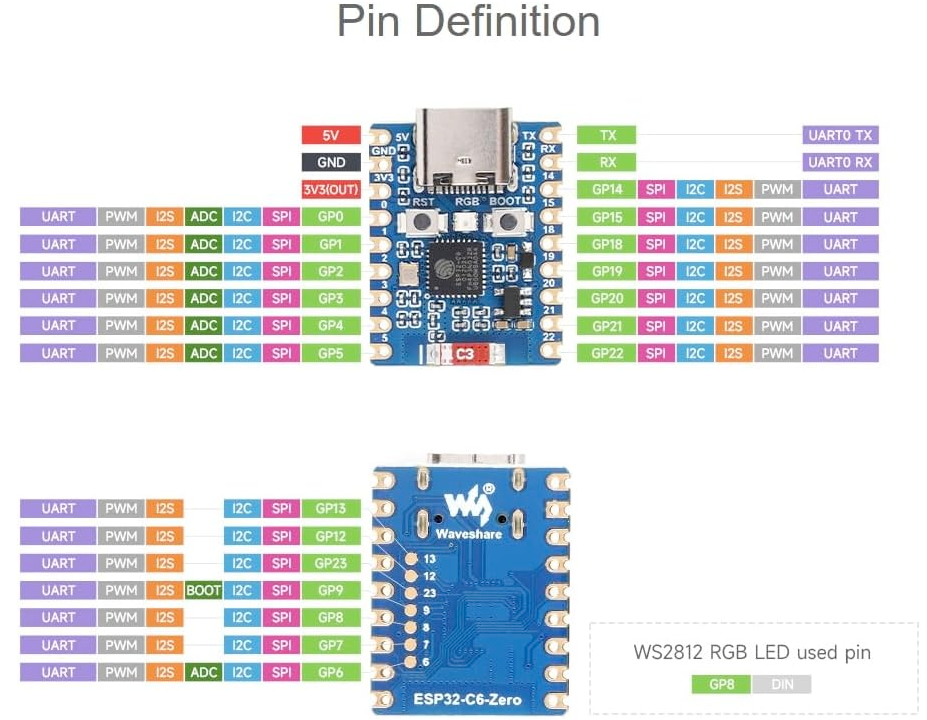
| Pin | GPIO | Labels | Status | Capabilities | Notes |
|---|---|---|---|---|---|
| 1 | - | 5V | power | - | 5V power input for the board |
| 2 | - | GND | ground | - | Ground connection |
| 3 | - | 3V33.3V | power | - | 3.3V power output for peripherals |
| 4 | - | TX | uart | uart | TX |
| 5 | - | RX | uart | uart | RX |
| 6 | 0 | IO0GP0 | safe | adc | GPIO, ADC pin |
| 7 | 1 | IO1GP1 | safe | adc | GPIO, ADC pin |
| 8 | 2 | IO2GP2 | safe | adc | GPIO, ADC pin |
| 9 | 3 | IO3GP3 | safe | adc | GPIO, ADC pin |
| 10 | 4 | IO4GP4 | strapping | adc | GPIO, ADC pin |
| 11 | 5 | IO5GP5 | strapping | adc | GPIO, ADC pin |
| 12 | 6 | IO6GP6 | strapping | adc | GPIO, ADC pin |
| 13 | 7 | IO7GP7 | strapping | - | GPIO |
| 14 | 8 | IO8GP8 | strapping | - | GPIO, LED |
| 15 | 9 | IO9GP9 | strapping | - | GPIO, BOOT |
| 16 | 12 | IO12GP12 | uart | - | GPIO |
| 17 | 13 | IO13GP13 | uart | - | GPIO |
| 18 | 14 | IO14GP14 | safe | - | GPIO |
| 19 | 15 | IO15GP15 | strapping | - | GPIO |
| 20 | 18 | IO18GP18 | safe | - | GPIO |
| 21 | 19 | IO19GP19 | safe | - | GPIO |
| 22 | 20 | IO20GP20 | safe | - | GPIO |
| 23 | 21 | IO21GP21 | safe | - | GPIO |
| 24 | 22 | IO22GP22 | safe | - | GPIO |
| 25 | 23 | IO23GP23 | safe | - | GPIO |
Start with these
11 pins with no boot or system involvementFreely assignable - no strapping, flash, USB or JTAG duties. Ideal first picks for buttons, sensors and LEDs.
Fine - with a little care
sampled at boot or shared with debug/serial| Pin | Label | What to know | Role |
|---|---|---|---|
| IO4 | MTMS | Used during boot; required for JTAG debugging; flash data in internal-flash models. | Strapping |
| IO5 | MTDI | Used during boot; required for JTAG debugging; flash data in internal-flash models. | Strapping |
| IO6 | MTCK | Required for JTAG debugging; connected to flash clock in internal-flash models. | JTAG |
| IO7 | MTDO | Required for JTAG debugging; connected to flash data in internal-flash models. | JTAG |
| IO8 | GPIO8 | Determines boot mode; pulling low at reset can prevent normal boot. | Strapping |
| IO9 | GPIO9 | Pulling low on reset forces the ESP32-C6 into download mode instead of normal boot. | Strapping |
| IO15 | JTAG_SEL | Controls JTAG input source at boot; avoid altering its state. | JTAG |
Only if you know the tricks
wired to flash or USB - expect a fight| Pin | Label | What to know | Role |
|---|---|---|---|
| IO12 | USB_D- | Dedicated to USB communication; avoid if using USB functionality. | USB |
| IO13 | USB_D+ | Dedicated to USB communication; avoid if using USB functionality. | USB |
Pinout notes The ESP32 C6 Zero Mini breaks out 25 pins in total: 20 GPIO for your project, with 5V, GND and 3V3 handling power. On the analog side there are 7 ADC-capable…
The ESP32 C6 Zero Mini breaks out 25 pins in total: 20 GPIO for your project, with 5V, GND and 3V3 handling power.
On the analog side there are 7 ADC-capable pins for sensors and battery monitoring.
If you want zero surprises, IO0, IO1, IO2, IO3 and 7 more are free of any such role - the safest first picks. 7 of the exposed pins carry boot-time or system duties on the ESP32-C6 (IO4, IO5, IO6 and 4 more).
Getting started
flash your first firmware in ~2 minutesBoard: ESP32C6 Dev Module USB CDC On Boot: Enabled Flash Size: 4MB (32Mb) Flash Mode: QIO Partition Scheme: Default 4MB with spiffs (1.2MB APP/1.5MB SPIFFS) Upload Speed: 921600
// toggle GPIO0 - wire an LED and resistor to it
void setup() {
  pinMode(0, OUTPUT);
}
void loop() {
  digitalWrite(0, HIGH); delay(500);
  digitalWrite(0, LOW);  delay(500);
}[env:esp32-c6-zero-mini]
platform = https://github.com/pioarduino/platform-espressif32/releases/download/stable/platform-espressif32.zip
board = esp32-c6-devkitc-1
framework = arduino
monitor_speed = 115200
upload_speed = 921600esp32-c6-devkitc-1 - or type it after board =.esp32:
board: esp32-c6-devkitc-1
variant: esp32c6
framework:
type: esp-idf
# blink - GPIO0
output:
- platform: gpio
pin: 0
id: led_out
light:
- platform: binary
name: "LED"
output: led_outesp32-c6-devkitc-1 (same ids as PlatformIO).esptool.py --chip esp32c6 --port /dev/ttyACM0 \
--baud 921600 write_flash 0x0 firmware.bin--port = your /dev/tty* (macOS/Linux) or COMx (Windows).Specifications
ESP32-C6 · 23.5 × 18 mm · vs other ESP32 chips →About this board
At 23.5 × 18 mm it's among the smallest boards in the whole ESP32 family.
Inside sits the ESP32-C6 - a RISC-V part adding Wi-Fi 6 plus Thread/Zigbee radios. Sibling Zero-format boards cover the ESP32-C3 and ESP32-S3, so you can change radios or horsepower without changing the footprint.
It's the only ESP32-C6 option in the Zero-format family.
Expect to pay about $10.00 - above the ~$6.27 typical for Zero-format boards.
Onboard you'll find an addressable RGB LED (GPIO8) and Reset/Boot buttons.
It flashes over native USB - no serial-converter driver needed.
- ESP32-C6FH4: Built-in dual processors, main frequency is up to 160 MHz
- USB Type-C Port for downloading programme and debugging
- ME6217C33M5G low dropout LDO, 800mA (Max)
- WS2812 RGB LED
- 2.4G ceramic antenna
- BOOT button: Press it and then press the RESET button to enter download mode
- RESET button
- ESP32-C6FH4 pins
Where to buy
prices are typical street pricesResources
Similar boards
All Zero boards →

