
Espressif ESP32-C3-Lyra
ESP32-C3 board designed for audio and voice applications - perfect for smart speakers and sound-triggered systems.

Pinout
17 pins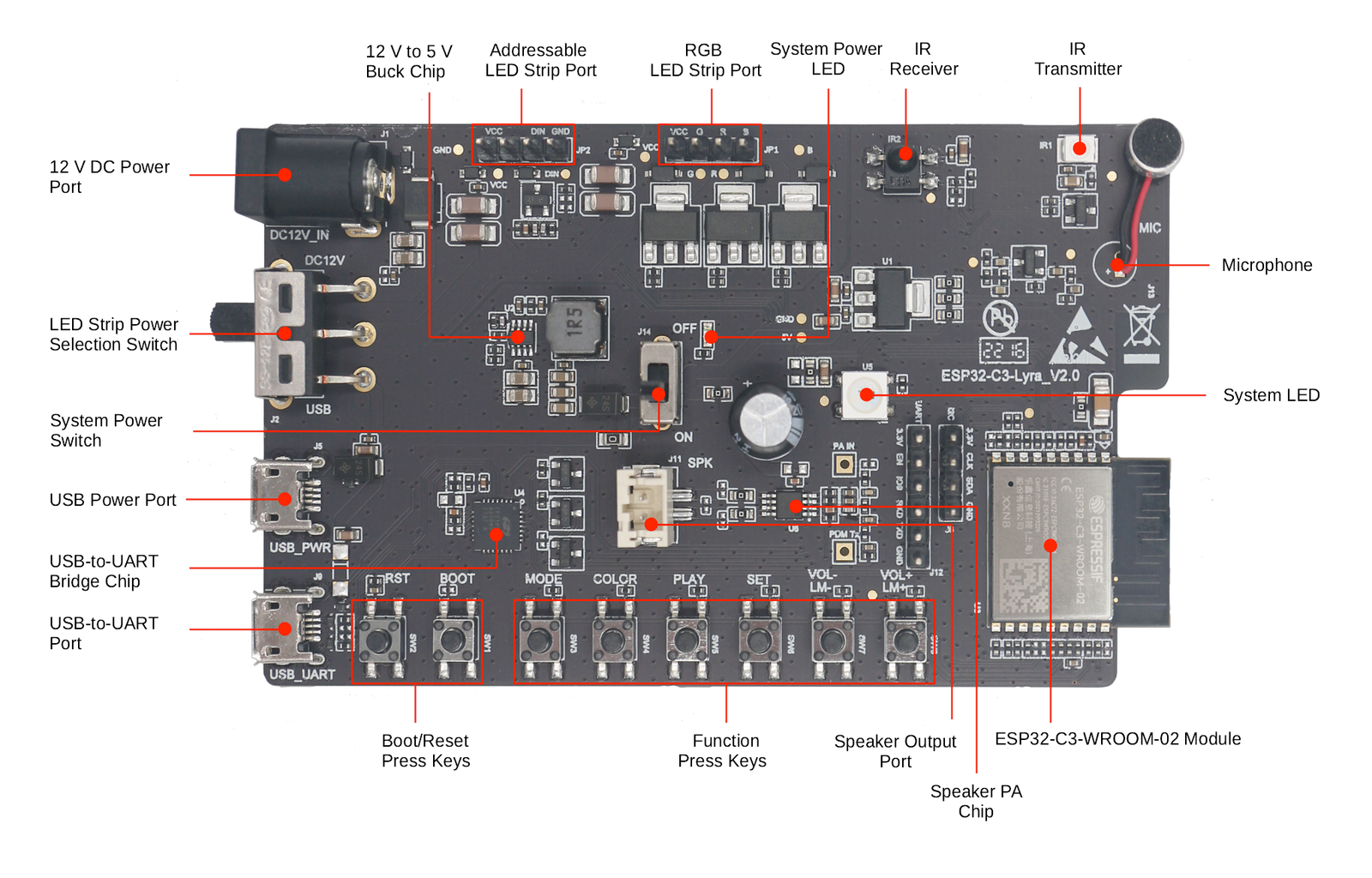
| Pin | GPIO | Labels | Status | Capabilities | Notes |
|---|---|---|---|---|---|
| 1 | - | 3V33.3V | power | - | 3.3V rail (UART header) |
| 2 | - | ENRST | control | - | Chip enable / reset, active low (UART header) |
| 3 | 9 | IO9BOOT | strapping | pwm | GPIO9 BOOT strapping pin; UART download mode (UART header) |
| 4 | - | RXDRX | uart | uart | UART receive (UART header) |
| 5 | - | TXDTX | uart | uart | UART transmit (UART header) |
| 6 | - | GND | ground | - | Ground (UART header) |
| 7 | - | 3V33.3V | power | - | 3.3V rail (I2C header) |
| 8 | - | CLKSCL | safe | i2c | I2C clock (I2C header) |
| 9 | - | SDA | safe | i2c | I2C data (I2C header) |
| 10 | - | GND | ground | - | Ground (I2C header) |
| 11 | - | VCC | power | - | Addressable LED strip power (JP2) |
| 12 | - | DIN | safe | - | Addressable LED strip data in (JP2) |
| 13 | - | GND | ground | - | Ground (JP2) |
| 14 | - | VCC | power | - | RGB LED strip power (JP1) |
| 15 | - | GGreen | safe | - | RGB LED strip green channel (JP1) |
| 16 | - | RRed | safe | - | RGB LED strip red channel (JP1) |
| 17 | - | BBlue | safe | - | RGB LED strip blue channel (JP1) |
Fine - with a little care
sampled at boot or shared with debug/serial| Pin | Label | What to know | Role |
|---|---|---|---|
| IO9 | GPIO9 | Controls boot mode on reset (HIGH for normal flash boot, LOW enters serial download mode) | Strapping |
Pinout notes Across 17 pins, the Espressif ESP32-C3-Lyra exposes 1 GPIO plus 3V3, GND and VCC for power. Beyond plain digital I/O you get PWM on every GPIO. 1 of the…
Across 17 pins, the Espressif ESP32-C3-Lyra exposes 1 GPIO plus 3V3, GND and VCC for power.
Beyond plain digital I/O you get PWM on every GPIO.
1 of the exposed pins carry boot-time or system duties on the ESP32-C3 (IO9) - check the guidance above before wiring anything to them.
Getting started
flash your first firmware in ~2 minutesBoard: ESP32C3 Dev Module Flash Size: 4MB (32Mb) Flash Mode: DIO Partition Scheme: Default 4MB with spiffs (1.2MB APP/1.5MB SPIFFS) Upload Speed: 921600
// toggle GPIO8 - wire an LED and resistor to it
void setup() {
  pinMode(8, OUTPUT);
}
void loop() {
  digitalWrite(8, HIGH); delay(500);
  digitalWrite(8, LOW);  delay(500);
}[env:esp32-c3-lyra]
platform = espressif32
board = esp32-c3-devkitm-1
framework = arduino
monitor_speed = 115200
upload_speed = 921600esp32-c3-devkitm-1 - or type it after board =.esp32:
board: esp32-c3-devkitm-1
variant: esp32c3
framework:
type: esp-idf
# blink - GPIO8
output:
- platform: gpio
pin: 8
id: led_out
light:
- platform: binary
name: "LED"
output: led_outesp32-c3-devkitm-1 (same ids as PlatformIO).esptool.py --chip esp32c3 --port /dev/ttyACM0 \
--baud 921600 write_flash 0x0 firmware.bin--port = your /dev/tty* (macOS/Linux) or COMx (Windows).Specifications
ESP32-C3 · vs other ESP32 chips →About this board
Inside sits the ESP32-C3 - a single-core RISC-V and the budget low-power pick.
At $28.00 it's on the expensive side for an ESP32-C3 board - most land around $10.
Only 1 GPIO are broken out, where most ESP32-C3 boards manage about 13 - worth checking the pinout covers what you need.
Around the module: a microphone (ECM), a speaker connector (2.0mm pitch), an amplifier (NS4150), an addressable RGB LED (GPIO10), an IR transceiver, status LEDs (Power) and Boot/Reset/Mode/Color/Play/Pause/Set/Vol+/Vol- buttons.
The ESP32-C3-Lyra is an audio development board based on the ESP32-C3 module, designed for controlling light with audio. It features a built-in ECM microphone, speaker power amplifier, and speaker connector, making it ideal for applications such as audio broadcasters and rhythm light strips. The board also supports infrared (IR) transmitting and receiving, and provides connectors for both addressable and RGB LED strips.
Where to buy
prices are typical street pricesResources
Similar boards


